
THE GREAT FRONTIER: GHOSTS IN THE VELVET SILENCE
The world at three in the morning is a different planet. Away from the hum of city grids and the artificial amber of streetlights, the air turns sharp and the silence takes on a physical weight. You stand in the darkness, your eyes slowly adjusting to the deep violet of the pre-dawn sky. This is the realm of the observer, a place where the barrier between our small, rocky home and the infinite vacuum of the cosmos feels thin enough to touch.
High above, billions of miles of nothingness stretch out, punctuated only by the ancient light of suns that may have already died. But tonight, we are not looking for the permanent stars. We are hunting for ghosts. We are waiting for the Eta Aquariids, a meteor shower that is less a display of fire and more a whispered conversation with one of the most famous travelers in human history. To see them is to witness the debris of a giant, a trail of cosmic breadcrumbs left behind by the legendary Halley’s Comet. As we approach the peak of this celestial event in early May 2026, we find ourselves standing at the edge of a great mystery, watching the atmosphere ignite with the remnants of the past.
THE TECHNICAL MARVEL: AN ATMOSPHERIC ARCHAEOLOGY
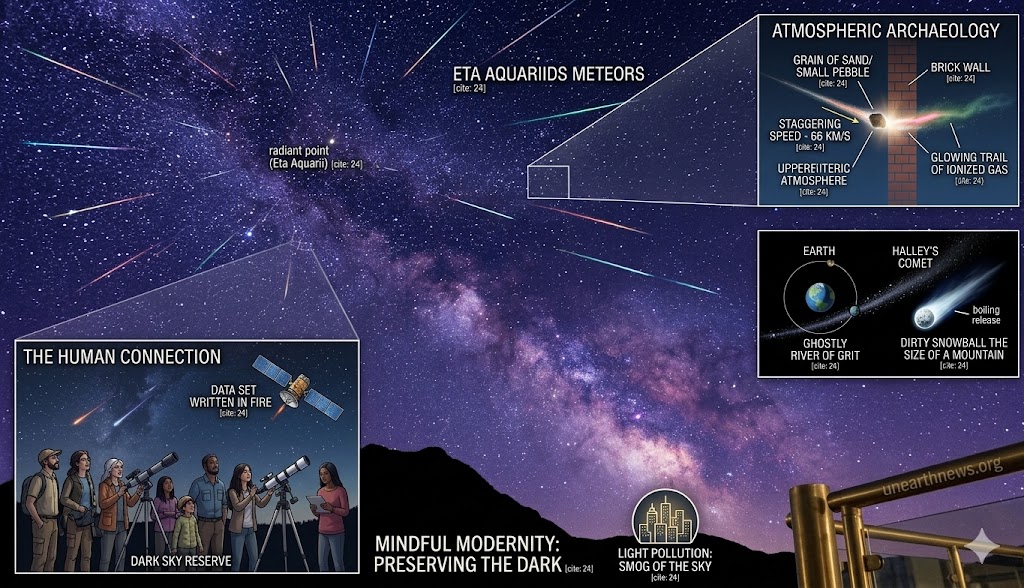
To understand the Eta Aquariids, one must understand the mechanics of a cosmic collision. Imagine a comet as a dirty snowball the size of a mountain, hurtling through the solar system. As it nears the sun, the heat causes its icy surface to boil away, releasing a chaotic stream of dust, rock, and gas. This debris doesn’t just disappear. It stays trapped in an orbital ring, a ghostly river of grit that follows the path of the comet across the void.
Every year, like a ship sailing through a patch of fog, the Earth’s orbit carries us directly through this stream of debris. The particles we encounter are not massive boulders. Most are no larger than a grain of sand or a small pebble. However, they are traveling at staggering speeds—roughly 66 kilometers per second, or 148,000 miles per hour. At that velocity, even a speck of dust carries more kinetic energy than a speeding car.
When these tiny travelers hit our upper atmosphere, about 60 miles above the ground, the air acts like a brick wall. The friction is so intense that the air molecules are ripped apart, creating a glowing trail of ionized gas. This is the flash you see—a streak of light that lasts only a heartbeat. We call them shooting stars, but they are actually atmospheric archaeology. We are witnessing the incineration of material that was frozen in the heart of Halley’s Comet for billions of years, dating back to the very birth of our solar system.
The shower is named after the star Eta Aquarii, located in the constellation Aquarius. This is the radiant point, the spot in the sky from which the meteors appear to emerge. For those in the northern hemisphere, this point stays low on the horizon, making the meteors appear to skim across the top of the atmosphere. These are called earth-grazers—long, slow streaks that paint vibrant lines across the sky. In the southern hemisphere, the display is even more prolific, with dozens of flashes per hour lighting up the dark.
THE HUMAN CONNECTION: A BRIDGE ACROSS GENERATIONS
Why do we stand in the cold, straining our eyes for a glimpse of falling dust in 2026? It is because these meteors represent a rare form of continuity in an ever-changing world. Halley’s Comet, the source of this shower, has been documented by human civilizations for over two millennia. It was etched into Babylonian clay tablets, woven into the Bayeux Tapetery, and recorded by Chinese astronomers who saw it as a celestial omen.
When you see an Eta Aquariid streak across the sky, you are looking at the same material that our ancestors saw. You are participating in a ritual that spans the entire history of human curiosity. In an era where our lives are increasingly lived through digital screens and artificial intelligence, the meteor shower offers a grounding reality. It reminds us that we are part of a larger, mechanical system—a clockwork universe that moves with or without us.
In 2026, as we push further into space with renewed missions to the Moon and planned journeys to Mars, the Eta Aquariids serve as a reminder of the environment we are entering. Space is not empty; it is a dynamic, crowded highway of motion. By studying these tiny flashes of light, scientists can better understand the density of dust in the inner solar system, helping to protect our satellites and the brave explorers who will soon walk on other worlds. This is more than a light show; it is a data set written in fire.
MINDFUL MODERNITY: PRESERVING THE DARK
As we marvel at the vastness of the cosmos, we must also reflect on the fragility of our view from the ground. For millions of years, the night sky was the primary map, clock, and calendar for humanity. Today, that heritage is under threat. Light pollution—the “smog of the sky”—is washing out the stars at an alarming rate. For many people living in modern cities, the Milky Way is a myth, and a meteor shower is something they only see in high-definition photographs.
The hunt for the Eta Aquariids is a call to action for the preservation of our dark skies. Just as we fight to protect our oceans from plastic and our forests from destruction, we must fight to protect the integrity of the night. Dark sky reserves and light-shielding initiatives are not just for astronomers; they are for the preservation of human wonder. If we lose the ability to look up and see the universe, we lose a vital part of our identity.
Exploring the “vast unknown” of space actually teaches us about the “small home” we inhabit. The very atmosphere that incinerates these meteors is the same thin layer that keeps us alive, shielding us from radiation and the harsh vacuum of the void. Seeing a meteor die in a flash of light highlights the delicate balance of our planet. It encourages a perspective of sustainability—the realization that we live on a fragile vessel traveling through a high-velocity shooting gallery.
THE FINAL HORIZON: THE ETERNAL VOYAGE
The Eta Aquariid meteor shower will continue to return, year after year, until the last of Halley’s debris is swept up or pushed away by the solar wind. Eventually, the comet itself will return in 2061, swinging back around the sun to replenish the trail of dust it leaves behind. It is a cycle of renewal that operates on a scale far beyond a human lifetime.
As the sun begins to rise on the morning of May 6th, the stars will fade, and the meteors will become invisible, though they will continue to fall. The hunt ends for now, but the sense of wonder remains. We are a species of explorers, driven by an insatiable need to understand the dark places, whether they lie at the bottom of the Mariana Trench or in the far reaches of the Kuiper Belt.
The next time you find yourself under a clear night sky, take a moment to look up. Remember that those streaks of light are more than just dust; they are messengers from the deep past and heralds of the future. They remind us that the universe is alive with movement, beauty, and mystery. And as long as we keep looking up, the fire of exploration will never truly go out. The horizon is always there, waiting for the next generation of hunters to step into the dark and see what secrets the stars have to tell.