
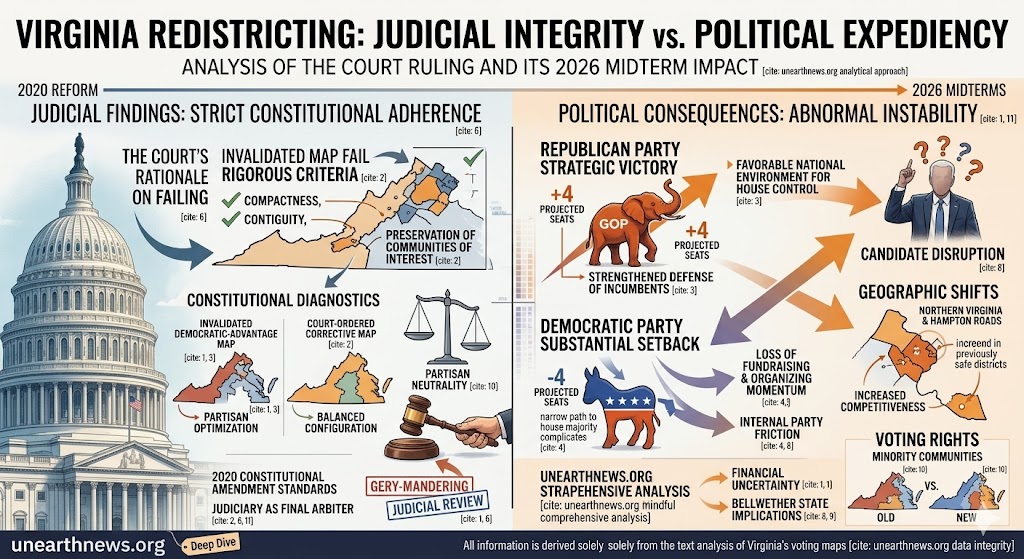
The recent judicial intervention by the Virginia court system to strike down the state’s redistricted voting map marks a consequential shift in the competitive landscape of the upcoming midterm elections. This decision effectively dismantles a map that had been optimized to provide the Democratic Party with a significant electoral advantage, potentially securing up to four additional seats in the House of Representatives. By nullifying these boundaries, the court has not only halted the immediate ambitions of Democratic strategists but has also validated the procedural concerns raised by Republican challengers who argued the map deviated from constitutional and statutory requirements. The ruling serves as a stark reminder of the judiciary’s role as a final arbiter in the contentious process of legislative reapportionment, where the intersection of law and politics often results in high-stakes litigation.
The core of the legal dispute centered on whether the proposed boundaries adhered to the standards set forth by the 2020 voter-approved constitutional amendment, which sought to reform the redistricting process. This amendment was designed to curb partisan gerrymandering by shifting the responsibility from the General Assembly to a bipartisan commission. However, when that commission reached an impasse, the responsibility fell to the courts and court-appointed special masters. The court’s decision to strike down the latest map suggests a finding that the redistricting plan failed to meet the rigorous criteria of compactness, contiguity, and the preservation of communities of interest, which are mandated by state law to ensure equitable representation across the Commonwealth.
For Republicans, this ruling represents a major strategic victory and a necessary corrective measure against what they characterized as an attempt to artificially inflate Democratic representation. The invalidated map would have placed several incumbent Republicans in precarious positions while carving out new, safely Democratic districts in rapidly growing suburban areas. With the map now set for a total overhaul or a return to a more balanced configuration, the GOP finds itself in a significantly stronger position to defend its current seats and compete for battleground districts that were previously trending away from them. This shift in the electoral map directly translates to a more favorable national environment for the Republican Party as it seeks to regain control of the House.
Conversely, the Democratic Party faces a substantial setback, as the loss of four projected seats complicates their narrow path to maintaining a majority in the House of Representatives. Strategists had relied on Virginia’s shifting demographics and the previous map’s favorable lines to offset potential losses in other regions of the country. The court’s decision forces a sudden and difficult pivot, as candidates who had already begun fundraising and organizing based on the invalidated boundaries now face the prospect of running in drastically different territories. This instability can lead to internal party friction, as incumbents and newcomers alike must navigate a revised political map that may no longer favor their specific platforms or historical voter bases.
The procedural history leading to this moment is rooted in the failure of the bipartisan redistricting commission, which was plagued by partisan gridlock since its inception. The inability of the commission to reach a consensus on either the congressional or state legislative maps necessitated judicial intervention, a scenario the 2020 amendment was specifically designed to avoid. The court’s recent ruling highlights the inherent difficulties in removing politics from redistricting, as even a process intended to be independent can result in legal challenges that ultimately place the final decision back into the hands of judges. This cycle of impasse and litigation underscores the complexity of defining “fairness” in a deeply polarized political environment.
From an analytical perspective, the striking down of the map reveals a judicial emphasis on strict adherence to constitutional mandates over political expediency. The court’s focus on the integrity of the process suggests that any map perceived as providing an undue advantage to one party at the expense of established districting principles will remain vulnerable to legal scrutiny. This creates a ripple effect throughout the state’s political infrastructure, as the criteria used by the court in this decision will likely serve as the benchmark for any future maps drawn by special masters or legislative bodies. This judicial scrutiny ensures that the spirit of the 2020 reform is upheld, even if it results in short-term political chaos.
The geographic implications of the court’s decision are particularly acute in Northern Virginia and the Hampton Roads area, where the invalidated map had sought to consolidate Democratic-leaning populations. By potentially redistributing these voters across multiple districts, a new map could restore competitiveness to districts that were previously considered “safe” for Democrats. Such a move would require Democratic candidates to appeal to a broader, more moderate constituency, rather than relying on concentrated urban and suburban cores. This change in voter composition changes not only the outcome of the elections but also the types of policy issues that will dominate the campaign trail, shifting focus toward broader regional concerns.
Candidate recruitment and fundraising are also expected to experience significant disruption in the wake of the ruling. High-profile donors and national political action committees often allocate resources based on the perceived “flippability” or safety of a district. With the lines in flux, the financial certainty that once underpinned Democratic campaigns in Virginia has evaporated. Donors may become more cautious, waiting for a final, court-approved map before committing the millions of dollars necessary to compete in expensive media markets like the D.C. suburbs. This financial hesitation can stall campaign momentum and give an advantage to better-funded incumbents or those with established grassroots support.
Furthermore, the ruling has national implications, as Virginia is often viewed as a bellwether for the country’s political direction. If the court-ordered map results in a more balanced or Republican-leaning delegation, it may signal a broader trend where judicial oversight serves as a check on Democratic efforts to utilize redistricting as a defensive tool. As both parties look toward the midterms, the Virginia decision will likely be cited in other state-level redistricting battles, providing a legal roadmap for challengers seeking to overturn maps they perceive as partisan gerrymanders. The national balance of power could very well hinge on the specific placement of boundary lines in a few key Virginia counties.
In the broader context of voting rights, the court’s decision is viewed through multiple lenses. Advocates for transparent redistricting may see the ruling as a victory for the rule of law, ensuring that maps are not drawn behind closed doors or with a thumb on the scale for one party. However, civil rights groups may express concern over how a redrawn map will affect the representation of minority communities. The court will need to balance the requirement of partisan neutrality with the mandates of the Voting Rights Act, ensuring that the new boundaries do not dilute the influence of historically marginalized groups who were concentrated in the now-invalidated districts.
As the legal process moves forward, the appointment of new special masters or the revision of existing proposals will be under intense public and political scrutiny. The court must act swiftly to finalize a map that can be implemented before upcoming primary deadlines, a timeline that leaves little room for further litigation. The outcome of this process will define Virginia’s political identity for the next decade, determining whether the state continues its trend toward becoming a reliable Democratic stronghold or returns to its roots as a highly competitive, purple battleground. Ultimately, the court’s decision has re-injected a high degree of volatility into a process that many hoped would be settled, ensuring that Virginia remains at the center of the national political conversation.