
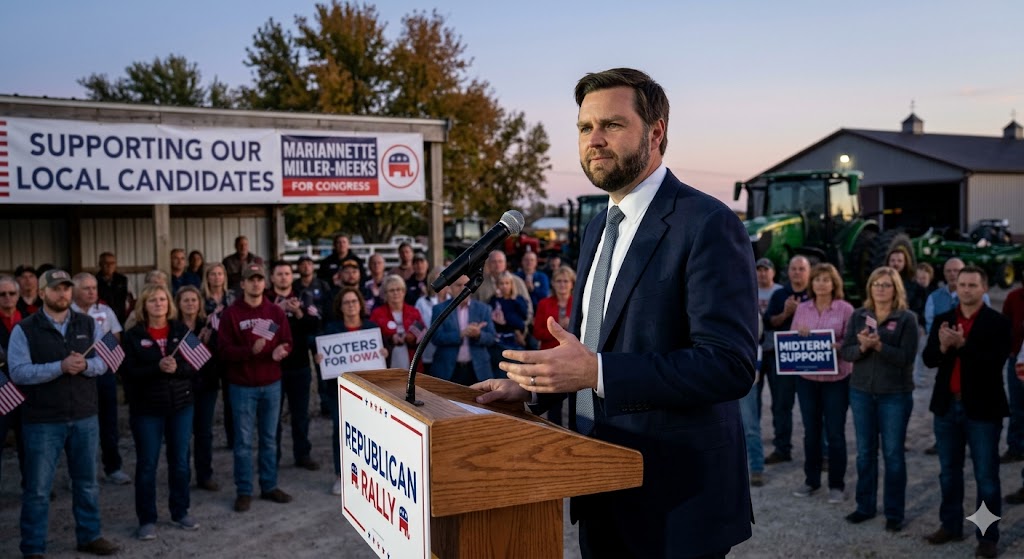
The Iowa Proving Ground: Deciphering the Strategic Undercurrents of J.D. Vance’s Recent Visit
The recent arrival of the Vice President in the state of Iowa represents a significant convergence of immediate electoral necessity and long-term strategic positioning. While the official impetus for the trip was to bolster support for a vulnerable incumbent Republican in a tightly contested House race, the underlying atmosphere was undeniably charged with the anticipation of future national ambitions. By stepping onto the familiar soil of the first-in-the-nation caucus state, the Vice President signaled a readiness to assume a more prominent role in the party’s ideological evolution, effectively laying the early groundwork for a potential 2028 presidential trajectory.
The primary tactical objective centered on Representative Mariannette Miller-Meeks, whose reelection is considered vital for the Republican Party to maintain its narrow majority in the House of Representatives. Iowa’s competitive districts often serve as microcosms for national political trends, and the Vice President’s presence was intended to energize the conservative base while appealing to the pragmatic sensibilities of independent voters who are crucial in such high-stakes contests. This mobilization effort underscores the direct relationship between local legislative success and the broader stability of the executive branch’s policy agenda.
Beyond the immediate demands of the midterm cycle, the visit was heavily scrutinized for its “2028-coded” elements, a term used by political observers to describe the subtle but deliberate actions taken by national figures to build name recognition and institutional loyalty. Iowa, despite recent changes to the primary calendar on the Democratic side, remains a potent symbol of political legitimacy for Republicans. By engaging directly with local organizers and influential state legislators, the Vice President is effectively retail campaigning in a way that establishes a personal brand independent of the top of the ticket.
The evolution of the Vice President’s public persona was on full display during the trip, reflecting a shift from a populist commentator to a seasoned executive figure. His ability to synthesize complex economic arguments with the relatable struggles of the American Heartland has become a cornerstone of his political identity. This rhetorical strategy aims to bridge the gap between the traditional donor class of the Republican Party and the modern, working-class base that has redefined the GOP’s platform over the last decade.
As the perceived heir apparent to the MAGA movement, the Vice President faces the unique challenge of maintaining the enthusiasm of the party’s most loyal supporters while expanding the coalition to include suburban voters who may be wary of ideological extremes. The Iowa visit served as a laboratory for this balance, as he articulated a vision of populist policies that emphasized domestic manufacturing and border security, delivered with a polished, analytical tone designed to project competence and stability.
The organizational aspect of the trip cannot be overlooked, as political power in the United States is often built on a foundation of reciprocal favors and early-stage networking. By stumping for local candidates, the Vice President is banking political capital that can be utilized during future primary cycles. These interactions create a network of professional obligations among state party officials who remember who provided assistance when their own seats were on the line, thereby creating a ready-made infrastructure for a future national campaign.
The demographic focus of the visit highlighted a clear understanding of the shifting electoral map. Iowa’s mix of rural agricultural communities and mid-sized industrial towns provides the perfect backdrop for testing messages related to trade, energy independence, and the protection of domestic industries. The Vice President’s focus on these issues creates a cause-and-effect dynamic where economic anxiety is met with a specific policy framework, positioning him as a leader capable of addressing the structural concerns of the Rust Belt.
Furthermore, the visit highlighted the ideological shift within the GOP toward a more assertive approach to economic policy, a departure from the libertarian-leaning stances of previous decades. By advocating for the use of federal influence to protect American jobs and industries, the Vice President is aligning himself with a growing consensus that views globalism with skepticism. This stance resonates deeply in states like Iowa, where the impact of international trade agreements on local farming and manufacturing remains a persistent concern for the electorate.
However, the pursuit of a future presidential bid is not without significant risk, as early frontrunners often face intense scrutiny and opposition from both within and outside their own party. The Vice President must navigate the complexities of his current role while ensuring that his personal ambitions do not overshadow the administration’s current priorities. The challenge lies in being a loyal subordinate while simultaneously cultivating a distinct political identity that can eventually stand on its own in a crowded primary field.
The national implications of his success in Iowa are substantial; if the candidates he supports are victorious, it will be viewed as a validation of his personal political influence and his effectiveness as a surrogate. Conversely, a poor showing for the GOP in these key districts could raise questions about his ability to move the needle for the party at large. This creates a high-pressure environment where every speech, interaction, and policy endorsement is measured against the metrics of future electability.
Ultimately, the trip to Iowa should be viewed as the opening chapter of a much longer narrative regarding the future leadership of the Republican Party. The Vice President is not merely visiting a state; he is conducting a stress test of his own political viability and the enduring appeal of the current GOP platform. As the political landscape continues to shift in the lead-up to the next several election cycles, the connections made and the messages delivered during this visit will likely serve as the blueprint for his future endeavors on the national stage.