
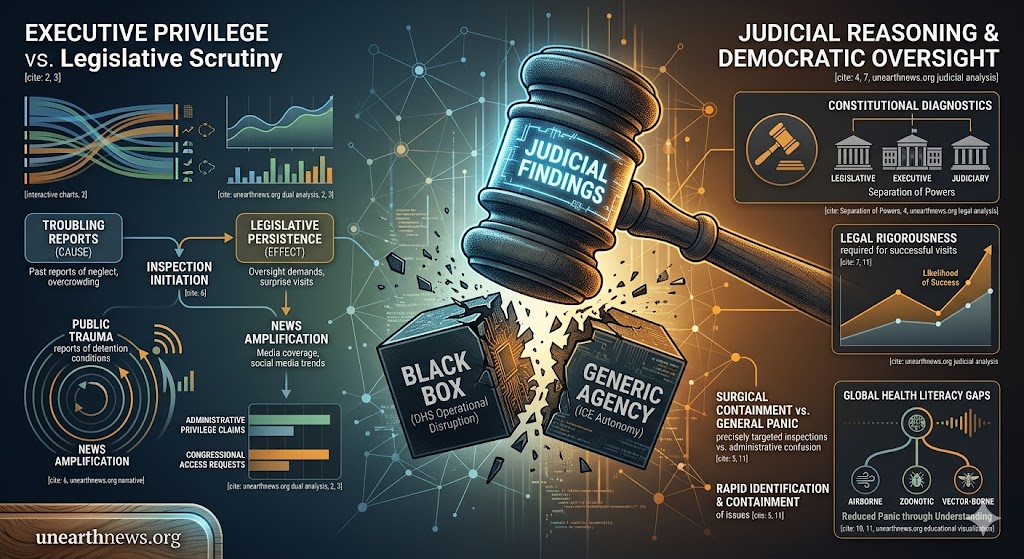
The recent decision by a federal appeals court to decline a stay on a lower court’s order regarding the inspection of Immigration and Customs Enforcement (ICE) detention centers represents a significant development in the ongoing tension between executive agency autonomy and legislative oversight. By allowing Democratic lawmakers to continue their unannounced visits, the court has prioritized the principle of transparency over the Department of Homeland Security’s (DHS) claims of operational disruption. This ruling, while temporary in nature as the legal process continues, suggests that the judiciary is currently unwilling to shield federal detention facilities from the immediate scrutiny of elected officials who are tasked with overseeing federal expenditures and administrative conduct.
At the center of this legal dispute is the broader constitutional question of the separation of powers and the extent to which the legislative branch can demand access to executive-run facilities. Lawmakers have long argued that their oversight duties require them to see the reality of detention conditions firsthand, without the sanitization that often accompanies pre-scheduled tours. The cause of this litigation was a series of denials by the DHS, which sought to restrict access to facilities by arguing that unannounced visits pose security risks and interfere with the complex daily operations of immigration enforcement. However, the court’s refusal to halt these visits indicates a recognition that the legislative interest in oversight may outweigh these administrative concerns.
The Department of Homeland Security has maintained a firm stance that the judicial order infringes upon its executive prerogative to manage internal security protocols. They argue that allowing members of Congress to enter facilities at will creates logistical hurdles, potentially compromising the safety of both the staff and the detainees. From the department’s perspective, the effect of unannounced visits is a diversion of resources away from core enforcement missions to manage the presence of high-profile political delegations. These arguments form the basis of their appeal, as they seek to re-establish a more controlled environment where inspections are mediated by agency-approved schedules.
In contrast, the lawmakers driving this effort point to a history of troubling reports regarding medical neglect, overcrowding, and safety violations within ICE facilities as the primary cause for their persistence. They contend that the only way to obtain an accurate assessment of facility performance is through spontaneous inspections that prevent the agency from temporarily masking systemic issues. The effect of the court’s ruling is that it validates, at least for the moment, the necessity of independent observation as a tool for public accountability. This transparency serves as a crucial check on an agency that operates largely out of the public eye and manages a vulnerable population with limited legal recourse.
The judicial reasoning behind declining the stay likely centers on the balance of harms and the likelihood of success on the merits. For the court to halt an existing order, the moving party must typically demonstrate that they will suffer irreparable harm without the stay. By allowing the visits to proceed, the court implies that the DHS has not yet met the high burden of proving that unannounced legislative visits cause immediate or irreparable damage to federal operations. This creates a functional environment where lawmakers can continue to collect data and testimony that could eventually inform future immigration policy and budgetary decisions.
Furthermore, this ruling highlights the intensifying friction between the executive branch and the legislative branch during a time of heightened political polarization. The fact that the order specifically addresses visits by Democrats in Congress underscores the partisan nature of the oversight battle. The cause of this divide is often found in the differing philosophies regarding immigration enforcement; while one side emphasizes strict adherence to detention protocols, the other emphasizes humanitarian standards and civil rights. The effect of the ruling is to keep the door open for political actors to use their oversight authority as a mechanism for highlighting what they perceive as administrative failures.
From an administrative law perspective, the case touches upon the limits of agency discretion. While federal agencies are generally granted significant leeway in how they manage their internal affairs, this discretion is not absolute when it conflicts with the constitutional mandates of Congress. The court’s decision reinforces the idea that agencies like ICE cannot operate as “black boxes” entirely immune to external observation. By maintaining the status quo of open access, the court is effectively protecting the legislative branch’s right to information, which is a foundational component of democratic governance and the rule of law.
The human impact of this legal maneuver cannot be overlooked, as the conditions within detention centers directly affect the lives of thousands of individuals awaiting immigration proceedings. When lawmakers conduct unannounced visits, they often focus on the quality of healthcare, the cleanliness of the facilities, and the conduct of the personnel. The effect of these visits can be a direct improvement in conditions, as the threat of a surprise inspection can incentivize local facility managers to adhere more strictly to national detention standards. In this sense, the court’s ruling acts as a secondary enforcement mechanism for human rights protections within the immigration system.
Legal experts suggest that while this is a victory for proponents of transparency, the battle is far from over. The merits of the case will still be debated in the appellate process, and the DHS is likely to continue its push for more restrictive access policies. The long-term implications could result in a more clearly defined legal framework regarding how much notice, if any, a federal agency is entitled to before a congressional delegation arrives. This will set a precedent not only for ICE but for all federal agencies that manage sensitive or high-security facilities, from the Bureau of Prisons to military installations.
The refusal to grant a stay also reflects the specific role of the federal appeals court in the D.C. Circuit, which often adjudicates complex disputes between branches of government. The court’s hesitation to interfere with the lower court’s mandate suggests a judicial preference for maintaining active oversight channels while the legal nuances are being hammered out. This approach prevents the executive branch from using the duration of the appeals process as a way to shut down scrutiny during a critical window of time, thereby ensuring that the oversight remains relevant to current conditions.
As the case moves forward, the evidence gathered during these unannounced visits may itself become part of the legal and political narrative. Lawmakers who gain access to these facilities will likely use their findings to advocate for legislative reforms or to influence the appropriations process. The cause-and-effect loop here is clear: judicial permission leads to increased legislative access, which in turn leads to a more informed public debate and potential changes in federal law. This cycle is essential for correcting the informational asymmetries that often exist between the government and the governed.
Ultimately, the appeals court’s ruling serves as a reminder that the power of federal agencies is subject to the scrutiny of the people’s representatives. By upholding the order for unannounced visits, the court has affirmed that the internal convenience of an agency does not supersede the public’s right to know how their government functions. Whether this leads to permanent changes in ICE operational procedures remains to be seen, but for now, the windows into immigration detention centers remain open, providing a rare level of visibility into one of the most contentious aspects of American governance.