
The Loneliest Travelers in the Dark
Imagine a world where the sun never rises. There is no dawn to break the heavy velvet of the atmosphere, no twilight to signal the end of a day. This world is not orbiting a star; it is not tethered to a solar system or held in the warm embrace of a nuclear furnace. It is a rogue planet, a free-floating ghost ship sailing through the crushing silence of the interstellar void. For decades, we believed these lonely spheres were the rarities of the cosmos, the tragic exceptions to the rule of planetary formation. We imagined them as cosmic accidents, few and far between.
However, the latest dispatches from the frontiers of astrophysics tell a far more crowded story. Far from being rare, these wanderers may be the most common residents of our galaxy. Recent models suggest that for every planet tucked safely in a stable orbit beyond its star cold reaches, there are nineteen others cast out into the dark. These are the Free Floating Planets, or FFPs, and their existence challenges everything we thought we knew about the stability of the heavens. In the vastness between the stars, where we once saw only empty space, there is a hidden population of billions, perhaps trillions, of worlds that have been forcibly exiled from their homes.
The Technical Marvel: Gravitational Billiards and the Snow Line
To understand how a planet becomes a pariah, we must look at the delicate architecture of a developing solar system. New research led by Xiaochen Zheng of the Beijing Planetarium has utilized sophisticated numerical simulations to act as a window into the chaotic youth of distant stars. These simulations function like a digital time machine, allowing scientists to hit fast-forward on millions of years of celestial movement to see how gravity sculpts the fate of newborn worlds.
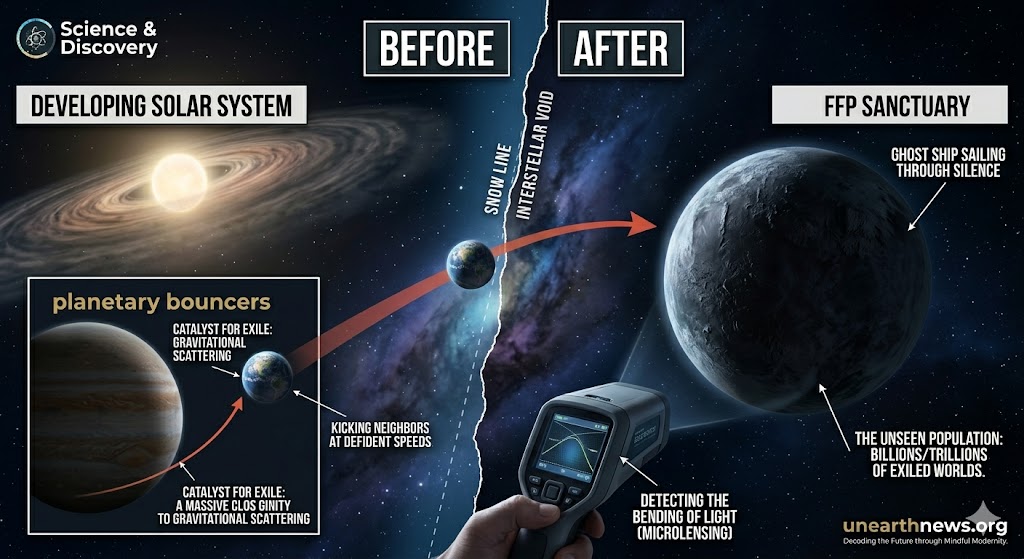
The key to this mystery lies in a boundary known as the snow line. In any solar system, there is a specific distance from the central star where the heat fades and the cold takes hold. Beyond this invisible frontier, compounds like water, ammonia, and methane can condense into solid ice. This is the birthplace of giants. Because there is more solid material available beyond the snow line, planets can grow larger and faster, eventually becoming gas giants or massive rocky worlds.
But this abundance creates a crowded, volatile environment. Zheng’s paper, currently circulating through the scientific community via the arXiv pre-print server, highlights a specific phenomenon that acts as a catalyst for exile: the planetary bouncers. These are massive, close-in planets that form or migrate near the star. Using their immense gravitational influence, they act like the enforcers of a high-stakes nightclub. When smaller, younger planets venture too close or find their orbits destabilized by the migration of these giants, the bouncers do not simply nudge them. They slingshot them. Through a process of gravitational scattering, these inner giants transfer enormous amounts of kinetic energy to their neighbors, kicking them out of the system entirely and sending them screaming into the void at speeds that defy the star’s ability to pull them back.
The Bouncers of the Inner Circle
The metaphor of a bouncer is particularly apt because it describes a position of power and gatekeeping. In the early stages of a solar system, gravity is a chaotic, invisible hand playing a game of cosmic billiards. When we look at our own solar system, we see a picture of clockwork perfection, with planets moving in predictable, nearly circular paths. But this stability is a hard-won peace.
Zheng’s research suggests that many systems never reach this equilibrium. Instead, the presence of large planets in the inner regions creates a permanent state of ejection. These massive bouncers effectively clear the room, ensuring that only the most stable or most massive residents remain. The lighter planets—the ones that might have become Earths or Mars-like worlds—are often the first to be tossed into the interstellar sea.
This discovery changes the math of the universe. If FFPs are nineteen times more common than planets orbiting in the cold outer reaches of stars, it means the galaxy is teeming with dark matter of a different kind—not mysterious subatomic particles, but physical, tangible worlds that we simply cannot see because they lack a star to illuminate them. They are the silent majority of the Milky Way, moving through the darkness like great whales in the deep ocean, invisible until they pass in front of a distant light source.
The Human Connection: Searching for Ghost Worlds in 2026
Why does this matter to us today, as we stand on the threshold of 2026? It matters because our definition of home is expanding. For the longest time, we looked at the stars and wondered if there were other earths circling other suns. Now, we must ask if there are other earths drifting between the suns.
This realization touches the very core of human curiosity. We have always been a species of explorers and migrants, and finding out that the universe itself is filled with nomadic worlds resonates with our own history. In 2026, we are deploying new tools—telescopes with lenses so sensitive they can detect the slight bending of light caused by the gravity of a rogue planet passing by. These instruments allow us to peer into the gloom and find the “unseen.”
Understanding rogue planets also helps us understand the fragility of our own existence. We live in a system where the bouncers were relatively well-behaved, or perhaps where the early chaos settled in a way that allowed Earth to remain in its golden cradle. To study an FFP is to study a “what if” scenario for our own planet. It reminds us that our stability is a gift of physics and time, a rare moment of balance in a galaxy that is often violent and exclusionary.
Mindful Modernity: Lessons from the Interstellar Void
As we look toward these vast, cold frontiers, there is a profound lesson for our stewardship of Earth. In the context of a galaxy filled with nineteen times more rogue planets than stable ones, our world appears even more like a miraculous sanctuary. Earth is not just a planet; it is a planet that survived the bouncers. It is a world that stayed in the warmth.
Exploring the vast unknown of the interstellar void reinforces the necessity of preserving our small home. When we see the sheer number of worlds that were cast out, left to freeze in the absolute zero of deep space, the value of our atmosphere, our liquid oceans, and our steady sun becomes immeasurable. Sustainability is not just a terrestrial concern; it is a cosmic realization. We are the inhabitants of a rare, anchored island in a sea of drifting ghosts. By studying the forces that create rogue worlds, we gain a deeper appreciation for the delicate gravitational dance that keeps our own climate stable and our life possible.
The Final Horizon: A Universe of Wanderers
The story of the planetary bouncers is a reminder that the universe is far more dynamic and perhaps far more crowded than our ancestors ever dared to dream. The stars we see in the night sky are merely the streetlamps of the galaxy, lighting up small pockets of space. But in the long, dark stretches between those lamps, the wanderers are moving.
They are worlds of frozen nitrogen, of mountains that have never felt the heat of a sun, and perhaps, in some cases, worlds with internal fires that keep hidden, subterranean oceans liquid for billions of years. As we continue to refine our models and launch our sensors into the deep, we are beginning to realize that to know the galaxy, we cannot just look at the light. We must learn to see the darkness.
One day, perhaps centuries from now, our descendants may visit one of these rogue worlds, landing on a surface that has known only the light of distant, flickering stars. Until then, we watch from our stable orbit, humbled by the knowledge that we live in a universe of wanderers, and grateful for the gravity that keeps us home. The stars are beautiful, but it is the silence between them that holds the greatest mysteries of all.