
Analyzing the Hantavirus Outbreak on the MV Hondius and the Evolution of Public Health Anxiety
The recent reports of fatalities aboard the Dutch cruise ship MV Hondius have reignited a specific brand of collective anxiety that has lain dormant since the height of the global pandemic. While health officials have been quick to identify Hantavirus as the causative agent, the mere sight of a quarantined vessel and the mobilization of medical teams in protective gear have triggered what many are calling “COVID PTSD.” This psychological phenomenon underscores the lasting impact of the 2020 lockdowns, where visual cues of infectious disease management now elicit immediate, often disproportionate, responses from a public conditioned to expect the worst. However, a deep epidemiological dive reveals that while the tragedy is significant, the biological nature of Hantavirus bears little resemblance to the respiratory pathogen that halted the world four years ago.
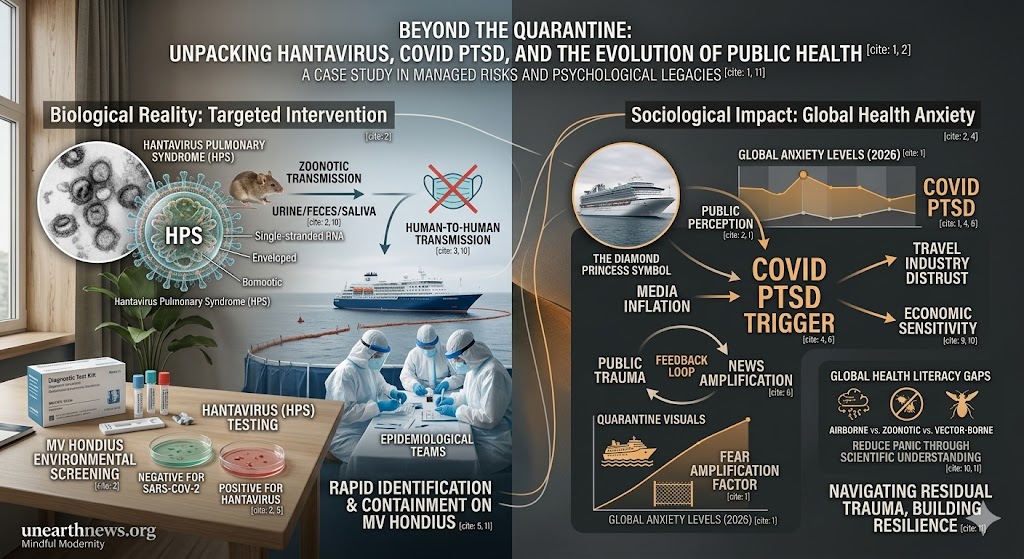
Hantavirus is primarily a zoonotic pathogen, meaning it is transmitted from animals to humans, specifically through contact with the saliva, urine, or feces of infected rodents. Unlike the SARS-CoV-2 virus, which spreads rapidly through aerosolized droplets and human-to-human contact, Hantavirus infections are typically isolated incidents related to environmental exposure. In the case of the MV Hondius, the cause-and-effect relationship likely stems from a localized breach in sanitation or the inadvertent presence of rodents in storage areas during the vessel’s travel through specific ecological zones. Because the virus does not transition easily between humans, the threat remains contained to those who shared the specific environment where the exposure occurred, rather than posing a risk of an exponential global outbreak.
The severity of Hantavirus cannot be understated, as it can lead to Hantavirus Pulmonary Syndrome (HPS), a condition with a high mortality rate characterized by sudden respiratory failure. The deaths aboard the cruise ship highlight the clinical challenge of diagnosing such rare diseases in a maritime environment. Early symptoms often mimic common influenza—fever, muscle aches, and fatigue—which can lead to a delay in critical care. The rapid progression from mild discomfort to severe distress is what makes the pathogen so lethal for the individual, yet its inability to maintain a sustained chain of human transmission acts as a natural biological firebreak, preventing the kind of societal disruption seen during the COVID-19 era.
Despite these clear biological differences, the sociological impact of the incident is profound. The image of a cruise ship—a symbol that became synonymous with the early failures of the COVID-19 response—serves as a potent trigger for public trauma. During the early days of 2020, vessels like the Diamond Princess became petri dishes for a misunderstood virus, leading to protracted quarantines and international panic. Consequently, when news broke of deaths on the MV Hondius, the public’s analytical processing was momentarily bypassed by an emotional reflex, demonstrating how deeply the pandemic has altered the global psyche regarding travel and infectious disease.
From an analytical perspective, the response by health authorities in this instance demonstrates a significant evolution in global health surveillance and containment strategies. Unlike the initial confusion of 2020, the identification of Hantavirus was relatively swift, and the isolation protocols were surgical rather than broad-brush. This shift from generalized panic to targeted epidemiological intervention reflects a matured public health infrastructure. The cause-and-effect here is clear: the lessons learned from the COVID-19 pandemic have equipped maritime and health officials with better tools for rapid diagnostic testing and containment, thereby mitigating the risk of a larger crisis before it can manifest.
The role of the media in shaping the narrative around the MV Hondius incident also warrants scrutiny. In an era where “viral” content is both a biological and a digital term, the use of terminology reminiscent of the pandemic can inadvertently amplify fear. By drawing parallels between Hantavirus and Coronavirus, even if only to debunk them, news cycles keep the public in a state of heightened alertness. This leads to a complex feedback loop where the public’s “COVID PTSD” is both a reaction to the news and a driver of the demand for more health-centric reporting, making it difficult for objective scientific facts to permeate the emotional noise.
Furthermore, this incident highlights the ongoing challenges of zoonotic disease monitoring in an increasingly interconnected world. As human activity expands into more remote areas and climate change alters the habitats of rodent populations, the frequency of “spillover” events—where a virus jumps from an animal host to a human—is expected to rise. The MV Hondius incident serves as a reminder that the next major health threat may not come from a known respiratory virus, but from an environmental pathogen that we are currently underestimating. Therefore, the long-term implication is a need for more robust environmental screening in the travel and cargo industries.
For the cruise industry, the MV Hondius deaths represent a significant PR challenge that necessitates a transparent and science-led response. The industry has spent billions of dollars on medical facility upgrades and air filtration systems since 2020, yet these measures are largely designed for respiratory threats. Hantavirus requires a different focus: rigorous pest control and environmental sanitation in dry-storage and ventilation areas. The cause-and-effect of these deaths will likely lead to a tightening of international maritime health regulations, specifically targeting rodent-borne illness prevention on passenger vessels.
The economic implications of such scares are also noteworthy. Tourism and international travel are highly sensitive to perceptions of safety. Even if a virus is not highly transmissible, the “fear factor” can lead to cancellations and a decline in consumer confidence. The analytical takeaway is that the travel industry must now manage not just the biological reality of disease, but the psychological legacy of the 2020 pandemic. Maintaining consumer trust requires a proactive approach to communication that clearly differentiates between various types of health risks, preventing a single isolated incident from being misconstrued as a systemic threat.
In terms of global health literacy, the reaction to the Hantavirus news reveals a gap in the public’s understanding of viral mechanics. Most people now view any “new” virus through the lens of the COVID-19 experience, assuming that all outbreaks follow the same trajectory toward a pandemic. Educating the public on the differences between zoonotic, vector-borne, and airborne pathogens is essential for reducing unnecessary panic. Deep-dive analysis suggests that the more the public understands the specific conditions required for Hantavirus to spread, the less power “COVID PTSD” will have over the collective consciousness.
Ultimately, the tragedy on the MV Hondius should be viewed as a localized public health failure rather than the harbinger of a new global catastrophe. The cause was an unfortunate environmental exposure, and the effect was a swift, if emotionally charged, institutional response. Moving forward, the focus must remain on strengthening zoonotic surveillance and improving the speed of diagnosis in remote or transit environments. While the ghosts of 2020 continue to haunt our reaction to health news, the reality is that our global capacity to identify and neutralize these threats has never been stronger.
In conclusion, the intersection of Hantavirus and the modern media landscape provides a fascinating study in public health psychology. While the virus itself is a formidable biological opponent, its lack of human-to-human transmissibility makes it a manageable risk within the framework of modern medicine. The true challenge lies in navigating the residual trauma of the pandemic era, ensuring that we react with scientific rigor rather than reflexive fear. By analyzing the MV Hondius incident through a lens of cause and effect, we can better prepare for future zoonotic events without falling into the trap of historical repetition.