
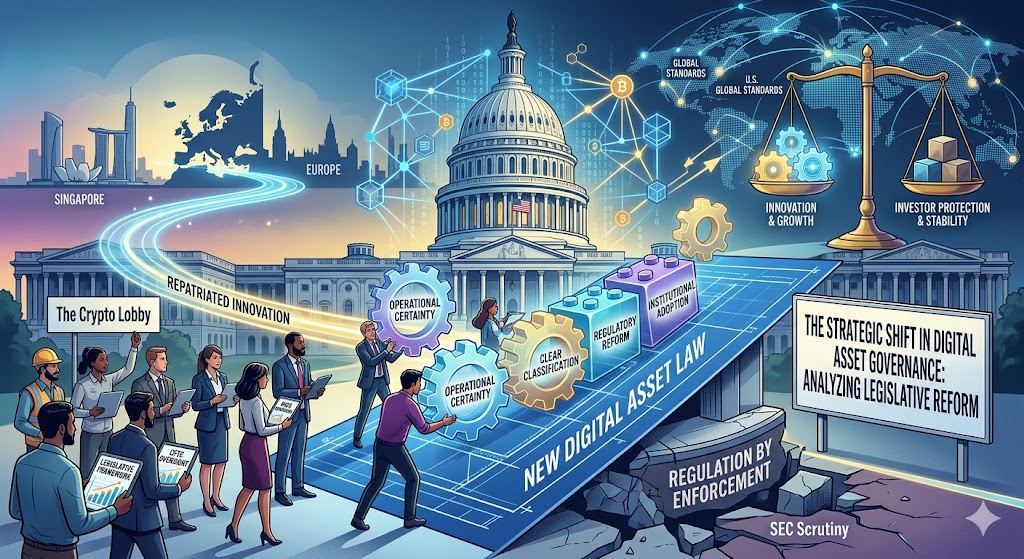
The Strategic Shift in Digital Asset Governance: Analyzing the Crypto Industry’s Push for Legislative Reform
The digital asset landscape in the United States is currently undergoing a seismic shift as the cryptocurrency industry leverages a series of recent political victories to reshape its regulatory environment. Following a period of intense scrutiny and high-profile enforcement actions, industry leaders have pivoted toward a more aggressive and coordinated lobbying strategy. This effort is focused on passing a sweeping legislative framework designed to provide the clarity firms have long demanded, while simultaneously tilting the balance of oversight in a direction more favorable to technological growth and market expansion.
This surge in political activity is largely a response to what many in the sector characterize as regulation by enforcement. For years, the Securities and Exchange Commission (SEC) has maintained an assertive posture, categorizing many digital assets as securities and pursuing legal action against major exchanges. The cause of the current legislative push is the industry’s desire to escape this perceived jurisdictional overreach. By supporting candidates who favor a more lenient approach and investing heavily in political action committees, the crypto sector has successfully elevated its policy priorities to the forefront of the national legislative agenda.
The proposed framework sought by these firms aims to redefine the classification of digital assets, effectively moving a significant portion of the market under the jurisdiction of the Commodity Futures Trading Commission (CFTC). The industry generally views the CFTC as a more principles-based and accessible regulator compared to the SEC. If successful, this reclassification would represent a fundamental change in how digital assets are governed, likely resulting in a more streamlined registration process for tokens and a reduction in the litigation risks that currently hinder long-term institutional investment.
The effectiveness of this lobbying effort can be traced back to the substantial financial resources deployed during recent election cycles. By becoming one of the largest sources of corporate political spending, the crypto industry has effectively signaled to lawmakers that its interests are tied to a significant and growing constituency. This financial influence has fostered a new environment in Washington where pro-crypto legislation is no longer seen as a niche interest but as a necessary component of modernizing the American financial system for the digital age.
Analytically, the primary driver behind this legislative push is the need for operational certainty. Multinational crypto firms have often cited the lack of a clear legal framework as the reason for relocating talent and capital to more hospitable jurisdictions like Europe or Singapore. By shaping the current bill, these firms are attempting to create a domestic environment that mirrors international standards such as the Markets in Crypto-Assets (MiCA) regulation in the European Union. The intended effect is to repatriate innovation and ensure that the United States remains the primary hub for blockchain-based financial technology.
However, the push for industry-friendly regulation is not without significant risks. Critics and consumer advocacy groups argue that the proposed framework may lack the rigorous investor protections necessary to prevent a recurrence of the collapses seen in 2022. The cause of these concerns lies in the industry-penned nature of some legislative language, which skeptics believe could create loopholes for risky lending practices or insufficient capital reserves. The tension between fostering innovation and ensuring market stability remains the central conflict in the current debate over the bill’s final provisions.
The political realignment following recent elections has provided the necessary momentum for this bill to move through congressional committees with unprecedented speed. The industry’s strategic focus on key leadership positions within financial services committees has ensured that the legislative language reflects their specific operational needs. This proactive approach marks a maturation of the sector; it is no longer merely reacting to regulatory pressure but is actively drafting the rules of the game to ensure its survival and integration into the broader financial system.
Institutional adoption is perhaps the most significant effect anticipated from the passage of this framework. Major traditional financial players, including hedge funds and asset managers, have largely remained on the sidelines or limited their exposure due to the lack of regulatory clarity. A definitive bill, even one that favors the industry, would provide the legal “green light” required for these institutions to integrate digital assets into their portfolios. This influx of capital would likely stabilize market volatility and increase the overall legitimacy of the asset class.
From a technological perspective, the bill also addresses the unique nature of decentralized finance (DeFi). The industry has lobbied for provisions that distinguish between centralized intermediaries and decentralized protocols. By ensuring that developers of open-source software are not held to the same compliance standards as traditional financial institutions, the bill aims to protect the core ethos of blockchain technology. This distinction is vital for the continued development of permissionless systems that do not rely on central authorities.
The implications of this legislative push extend beyond the borders of the United States. As the world’s largest economy, the regulatory stance adopted by the U.S. often sets the tone for global standards. If the industry-backed bill becomes law, it could trigger a “race to the top” among global regulators to provide similar levels of clarity and support for digital asset firms. Conversely, it could also lead to a more fragmented global regulatory landscape if other jurisdictions perceive the U.S. approach as being too lenient toward corporate interests at the expense of systemic stability.
Ultimately, the current push for a new crypto framework represents a defining moment for the intersection of technology, finance, and politics. The cause—a desire for regulatory relief and market legitimacy—has met a favorable political effect, resulting in a piece of legislation that could reshape the American economy for decades. While the bill’s final form will likely be the subject of intense negotiation, the crypto industry has already succeeded in proving that it is now a permanent and powerful fixture in the halls of government, capable of steering its own regulatory destiny.