
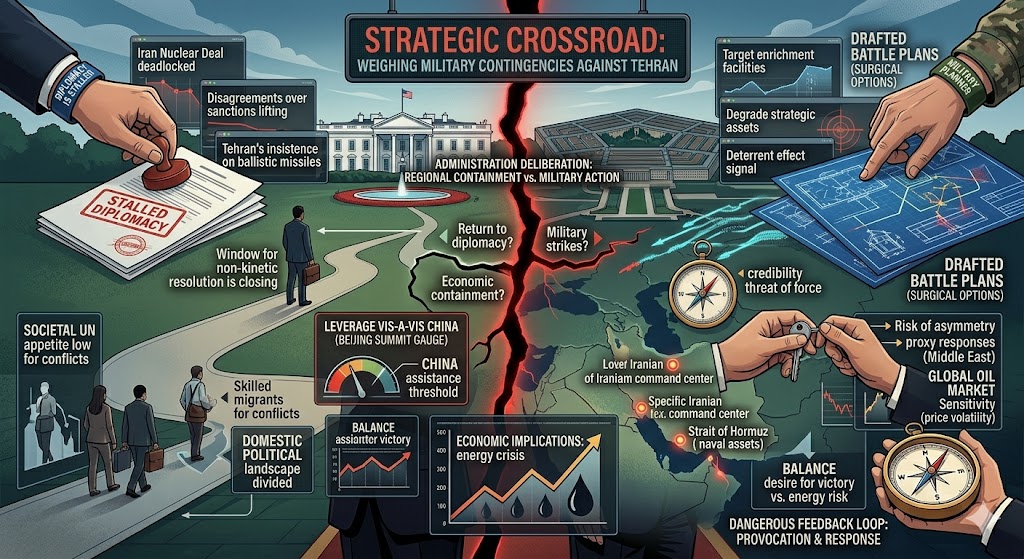
Strategic Crossroad as Administration Weighs Military Contingencies Against Tehran Following Stalled Diplomacy
Upon his return from a high-stakes diplomatic mission to China, President Trump faces an immediate and escalating crisis regarding the United States’ posture toward Iran. The transition from discussing global trade and regional security in Beijing to reviewing military options in Washington underscores a pivotal moment in American foreign policy. While the administration had previously prioritized a strategy of economic containment and diplomatic pressure, the recent stagnation of peace negotiations has forced a re-evaluation of the current trajectory. This shift indicates that the window for a non-kinetic resolution may be closing, as top advisors present the executive branch with a range of operational contingencies designed to address Iranian non-compliance.
The drafting of comprehensive battle plans by senior military and national security aides marks a significant departure from the rhetoric of the past several months. These documents are not merely theoretical exercises but are intended to provide the President with actionable pathways should the diplomatic deadlock persist. The primary cause of this escalation appears to be the perceived failure of the Iranian leadership to engage in what the administration deems “good faith” negotiations regarding its nuclear program and regional influence. Consequently, the effect has been a mobilization of the defense apparatus to ensure that the U.S. maintains a credible threat of force as a component of its broader geopolitical strategy.
Diplomatic efforts, which were once viewed as the primary vehicle for regional stability, have hit a formidable wall. Disagreements over the lifting of sanctions, coupled with Tehran’s insistence on maintaining its ballistic missile capabilities, have created an impasse that neither side seems willing to break. This lack of movement has emboldened hawks within the administration who argue that only a demonstration of military resolve will compel the Iranian government to reconsider its current path. As a result, the internal debate has shifted from how to entice Iran back to the table to how to effectively penalize its perceived intransigence.
The timing of this decision is intrinsically linked to the President’s recent interactions in China. Beijing remains a critical economic lifeline for Tehran, and any U.S. military action would have profound implications for Sino-American relations. It is highly likely that the administration used the summit to gauge China’s threshold for increased pressure on Iran. The geopolitical cause-and-effect here is clear: if the U.S. perceives that China will not assist in tightening the economic noose, the White House may feel that military strikes are the only remaining tool to achieve its objective of regional containment.
Military planners have reportedly focused on “surgical” options designed to degrade Iran’s strategic assets without triggering a full-scale regional war. These plans likely target command-and-control centers, enrichment facilities, and naval assets used to monitor the Strait of Hormuz. By drafting these specific battle plans, the administration aims to create a deterrent effect, signaling to Tehran that the “maximum pressure” campaign is entering a more volatile and physical phase. However, the risk of miscalculation remains high, as even limited strikes could provoke an asymmetric response from Iranian proxies across the Middle East.
From the perspective of Tehran, the threat of resumed strikes is viewed as a continuation of “economic terrorism” through military means. Iranian officials have historically responded to such pressure by increasing their defensive posturing and threatening to disrupt global energy flows. This cyclical pattern of provocation and response creates a dangerous feedback loop where both nations feel compelled to escalate to maintain domestic credibility and international standing. The failure of the most recent round of peace talks has only accelerated this momentum toward confrontation.
The economic implications of a potential return to military action are vast and immediate. Global oil markets are notoriously sensitive to instability in the Persian Gulf, and the mere discussion of battle plans is enough to trigger price volatility. A prolonged conflict or a blockade of shipping lanes would disrupt global supply chains already strained by post-pandemic recovery and ongoing trade disputes. For the Trump administration, the challenge lies in balancing the desire for a decisive foreign policy victory with the risk of an energy crisis that could dampen domestic economic growth.
Domestically, the President must navigate a divided political landscape where the appetite for another Middle Eastern conflict is historically low. While a segment of the electorate favors a hardline stance against Iran, others are wary of “forever wars” and the budgetary strain of increased military intervention. The administration’s decision-making process must therefore account for the political fallout of a military engagement that could potentially drag on without a clear exit strategy. This internal pressure serves as a counterweight to the more aggressive recommendations coming from the Pentagon and the State Department.
Regional allies, including Israel and Saudi Arabia, have long advocated for a more robust U.S. military presence to counter Iranian expansionism. Their intelligence sharing and logistical support are central to the battle plans currently under review. The cause for their support is the direct threat they feel from Iranian-backed groups in Lebanon, Yemen, and Iraq. The effect of their involvement is a more complex regional dynamic where a U.S. strike could be seen as an endorsement of a broader sectarian struggle, further complicating the prospects for long-term peace.
Modern warfare also introduces the dimension of cyber operations as a precursor or alternative to physical strikes. It is highly probable that the drafted plans include significant non-kinetic components aimed at neutralizing Iran’s communications and infrastructure. This approach allows for a level of plausible deniability and may mitigate some of the international condemnation that follows traditional bombardment. However, the transition from cyber warfare to physical strikes is a thin line that, once crossed, changes the nature of the engagement from a clandestine shadow war to an overt conflict.
As the President deliberates, the international community remains on edge, with European allies continuing to push for a return to the Joint Comprehensive Plan of Action (JCPOA) framework. The divergence between Washington’s military readiness and Europe’s preference for dialogue highlights a significant rift in the Western alliance. If the U.S. chooses to act unilaterally, it may find itself isolated on the global stage, even if its military objectives are achieved. This isolation could, in turn, drive Iran closer to the East, specifically strengthening its ties with Russia and China.
Ultimately, the decision to resume strikes or continue the current stalemate will define the administration’s foreign policy legacy for years to come. The intersection of stalled diplomacy and military preparedness has created a volatile environment where a single catalyst could spark a significant conflagration. Whether the battle plans remain on the shelf as a deterrent or are put into action depends on the President’s assessment of whether Iran can be coerced into a new agreement through force. The coming weeks will determine if the path forward leads toward a precarious peace or a new chapter of conflict in the Middle East.