
The Evolution of Immigration Enforcement: Analyzing the New DHS Re-Vetting Unit for Permanent Residents
The Department of Homeland Security has recently initiated a significant shift in its enforcement strategy, signaling a transition from focusing primarily on undocumented individuals to a more granular scrutiny of those who have already achieved legal status. The formation of a specialized unit tasked with re-vetting thousands of Lawful Permanent Residents marks a pivotal moment in the administration of immigration law. This development suggests that the status of “permanent residency” is being re-evaluated through a lens of continuous eligibility rather than a final administrative determination. By establishing this dedicated apparatus, the government is signaling that past approvals are no longer immune to retrospective audits, particularly when new data or investigative tools become available.
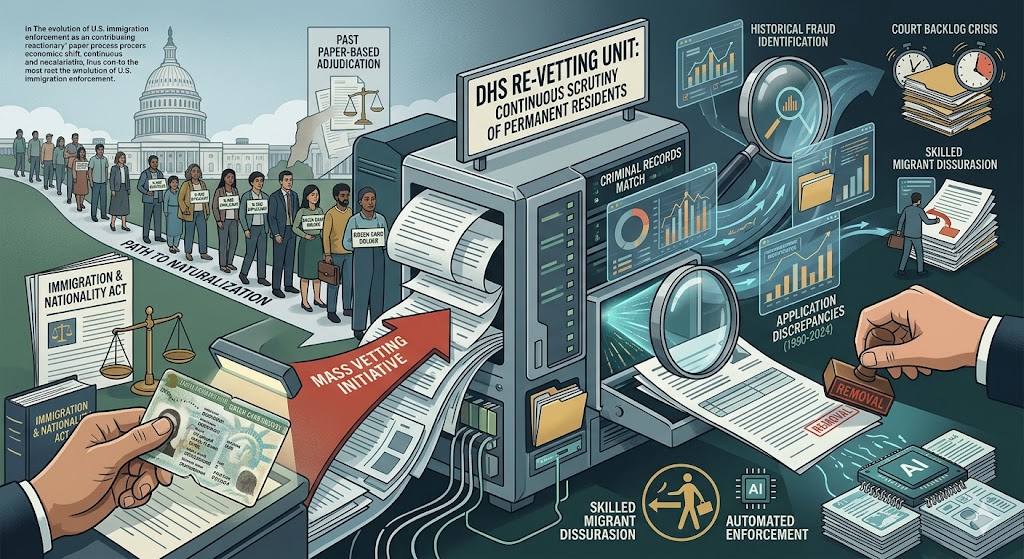
At the core of this initiative is the systematic utilization of enhanced data analytics and digitized historical records. In previous decades, immigration files were largely paper-based, making the cross-referencing of information across different agencies a labor-intensive and often inconsistent process. However, the modern “removal apparatus” leverages sophisticated software capable of identifying discrepancies between original visa applications, green card petitions, and current biographical data. This technological leap serves as the primary cause for the sudden feasibility of mass re-vetting, allowing the Department of Homeland Security to flag potential fraud or undisclosed criminal histories that may have been overlooked during the initial adjudication process.
The legal framework supporting this initiative is grounded in the Immigration and Nationality Act, which grants the executive branch broad powers to rescind residency if it is discovered that the status was obtained through willful misrepresentation of a material fact. While the power to deport green card holders has always existed, the creation of a dedicated unit specifically for this purpose represents a shift toward a proactive rather than reactive enforcement model. The effect of this institutional change is a heightened standard of scrutiny that follows immigrants long after they have integrated into the domestic workforce and their local communities.
One of the primary drivers behind this policy shift is the objective of maintaining the integrity of the legal immigration system. Proponents argue that by identifying and removing individuals who obtained their status through fraudulent means, the government ensures that the system remains fair for those who follow the rules. This cause-and-effect relationship suggests that a more rigorous enforcement of existing laws will act as a deterrent against future administrative fraud. However, the breadth of the re-vetting process also implies that even minor clerical errors or long-forgotten omissions from decades prior could now serve as the basis for removal proceedings.
The formation of this unit has sent a wave of apprehension through the legal community and immigrant advocacy groups. The primary concern is the potential for a “chilling effect” on the naturalization process. Historically, applying for citizenship was seen as the final step in securing one’s place in the country, but the new vetting unit often targets individuals exactly at this stage. When a permanent resident submits an N-400 application for naturalization, their entire immigration history is reopened for review. If the new unit finds a reason to challenge the original green card, the applicant may find themselves in deportation proceedings rather than at a naturalization ceremony.
Furthermore, the systemic impact of these audits extends to the judicial branch. The immigration court system is already facing an unprecedented backlog of cases, and the addition of thousands of complex litigation matters involving permanent residents will likely exacerbate these delays. Unlike undocumented individuals who may have fewer legal protections, green card holders are entitled to more robust due process rights, meaning these cases often involve lengthy legal battles. The cause—increased administrative scrutiny—leads directly to the effect of a further strained judicial infrastructure, potentially delaying justice for all parties involved in the immigration system.
From a policy perspective, the creation of this unit reflects a broader trend toward the securitization of immigration. In the post-9/11 era, immigration has increasingly been viewed through the prism of national security. The re-vetting apparatus is a manifestation of this ideology, operating on the principle that the government must have the ability to continuously verify the background of every non-citizen within its borders. This approach shifts the burden of proof onto the individual, who may be required to produce documentation or evidence regarding events that occurred twenty or thirty years ago to defend their right to remain in the country.
The psychological impact on the affected communities is another significant consequence of this policy change. For many permanent residents, the green card represented a sense of finality and security. The realization that this status can be revoked through a retrospective audit creates an environment of perpetual uncertainty. This instability can influence economic decisions, such as purchasing a home or starting a business, as individuals weigh the risk of sudden legal challenges to their residency. Consequently, the social fabric of immigrant communities may be altered as the perceived “permanence” of their legal status begins to erode.
In analyzing the motivations for this unit, one must also consider the political landscape. Immigration enforcement is often used as a tool to demonstrate administrative competence and a commitment to the rule of law. By targeting fraud within the legal system, the Department of Homeland Security can argue that it is prioritizing high-value enforcement actions. However, the deep-dive into old records also raises questions about the finality of administrative decisions. If the government can reopen a case indefinitely, the principle of administrative closure is undermined, potentially leading to a lack of confidence in the reliability of government-issued statuses.
Internationally, this shift in policy may influence how the United States is perceived by skilled migrants and global talent. A system that is seen as unpredictable or retroactively punitive may deter highly qualified individuals from seeking long-term residency. If the path to citizenship is perceived as a legal minefield rather than a clear progression, the U.S. may lose its competitive edge in attracting the global workforce. The cause of stricter internal auditing, therefore, has a potential external effect on the country’s soft power and economic attractiveness on the world stage.
The operational logic of the new unit also suggests a move toward “automated enforcement.” As artificial intelligence and machine learning become more integrated into government databases, the ability to scan millions of records for anomalies will only increase. This suggests that the current unit may be the precursor to an even more expansive and automated system of continuous vetting. The evolution of this technology means that the scope of the “removal apparatus” is likely to expand, covering a wider range of activities and biographical details that were previously beyond the reach of manual investigators.
Ultimately, the Department of Homeland Security’s decision to target permanent residents for re-vetting represents a fundamental transformation of the American immigration landscape. It prioritizes a rigorous, data-driven approach to enforcement that challenges the traditional understanding of residency. While the stated goal is to protect the integrity of the system and address fraud, the broader implications include increased legal volatility, a more burdened court system, and a shift in the social and psychological contract between the state and its legal residents. As this unit continues its work, the legal and social definition of “permanent” residency will likely continue to be reshaped by the dictates of modern security and administrative oversight.