
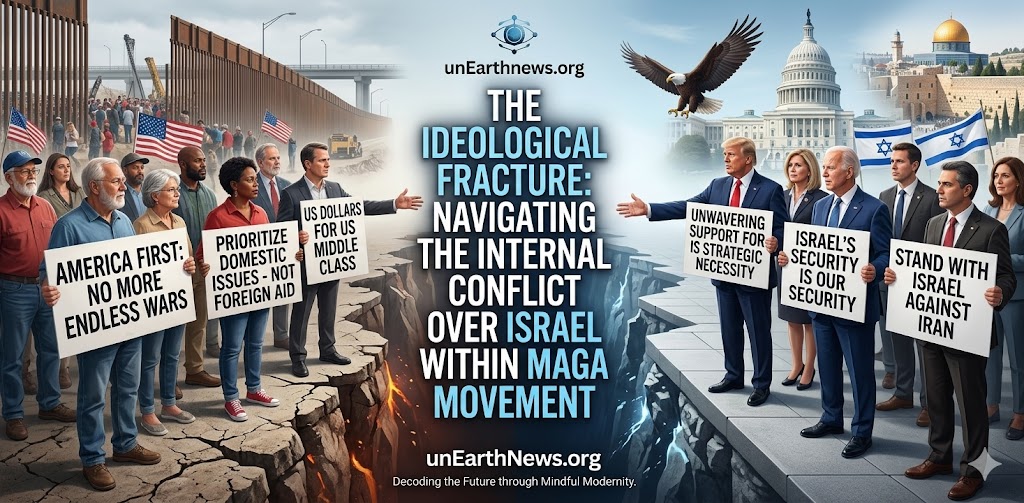
The Ideological Fracture: Navigating the Internal Conflict Over Israel Within the MAGA Movement
The geopolitical landscape of the Middle East has long served as a cornerstone of American conservative foreign policy, yet recent escalations involving Israel and Iran have catalyzed a profound ideological shift within the Make America Great Again movement. Traditionally, the Republican base maintained a monolithic stance of unwavering support for the Jewish state, driven by a combination of evangelical theology, strategic security interests, and a shared opposition to regional adversaries. However, the current conflict has exposed a tectonic rift, revealing that the “America First” doctrine is no longer a unified front regarding overseas involvement. This internal struggle represents a departure from decades of orthodoxy, as a new generation of populist voices challenges the necessity and cost of maintaining traditional alliances.
The cause of this shift can be traced back to the fundamental evolution of the “America First” philosophy itself. While Donald Trump’s presidency was marked by significant pro-Israel milestones, such as the relocation of the American embassy to Jerusalem and the brokering of the Abraham Accords, his underlying rhetoric emphasized a withdrawal from “endless wars” and a skepticism of foreign aid. As the war in Gaza has progressed and tensions with Iran have intensified, a vocal faction of the far-right has interpreted this isolationist streak more literally. For these individuals, the financial and military resources directed toward the Middle East are seen as a distraction from domestic priorities, such as border security and economic protectionism, leading to a direct confrontation with the movement’s more traditional hawkish elements.
This internal friction is exacerbated by a broader bipartisan trend in American public opinion, which has shown a measurable cooling toward unconditional support for Israeli military operations. Within the MAGA ecosystem, this manifests as a generational and ideological divide between the “Old Guard” of neo-conservatives who transitioned into the movement and the “New Right” who reject the interventionist consensus of the post-9/11 era. The effect of this divide is a fragmented messaging strategy, where some influencers demand total victory for Israel while others use their platforms to question why American taxpayer dollars are being utilized to subsidize a foreign military during a period of domestic inflation and infrastructure decay.
The role of Iran in this dynamic is particularly complex, acting as both a unifying threat and a point of contention. For the traditionalists within the MAGA movement, Iran remains the ultimate existential threat that justifies a robust military partnership with Israel. They argue that a retreat from the region would embolden Tehran, eventually necessitating a much larger and more costly American intervention. Conversely, the isolationist wing views the prospect of a direct war with Iran as a catastrophic outcome to be avoided at all costs. They fear that a “blank check” policy for Israel could inadvertently drag the United States into a regional conflagration, effectively violating the core promise of the Trump era to keep American troops out of foreign conflicts.
Alternative media and social platforms have played a pivotal role in accelerating this ideological drift. Unlike previous decades, where conservative thought was largely mediated through a few major television networks and publications, the current landscape allows for a decentralized debate. High-profile pundits and internet personalities have begun to openly criticize the influence of pro-Israel lobbying groups, suggesting that their interests do not always align with a strictly defined “America First” agenda. This has created a feedback loop where grassroots skepticism of foreign entanglements is amplified, making it increasingly difficult for the Republican leadership to maintain a disciplined, pro-Israel narrative without facing backlash from their own base.
Donald Trump’s own rhetorical ambiguity has further complicated the situation. While he often touts his record as the “most pro-Israel president in history,” he has also publicly expressed personal grievances with Prime Minister Benjamin Netanyahu and criticized the optics of the ongoing military campaign. By framing his support in transactional terms rather than purely ideological ones, Trump has inadvertently provided his followers with the permission to scrutinize the relationship. The effect is a base that is no longer operating on a shared set of assumptions, where loyalty to Trump does not automatically equate to loyalty to the traditional alliances he once championed.
The implications of this shift extend far beyond the borders of the MAGA movement, potentially reshaping the future of the Republican Party’s platform. If the isolationist wing continues to gain ground, the GOP may find itself in a position where it can no longer guarantee the same level of military and diplomatic support that Israel has relied upon for decades. This would represent a fundamental realignment of American politics, as the pro-Israel consensus that once enjoyed broad bipartisan support becomes a point of contention on both the far-left and the far-right, albeit for different ideological reasons.
Economic concerns also fuel this shift, as the cause-and-effect relationship between foreign aid and domestic deficit spending becomes a central talking point. As the United States grapples with a high national debt, the populist wing of the movement argues that every dollar sent abroad is a dollar stolen from the American worker. This fiscal populism has proved to be a powerful tool for those looking to distance the movement from its pro-Israel roots, as it frames the debate not as a matter of foreign policy, but as a matter of economic survival for the American middle class.
In response to this growing dissent, pro-Israel organizations and traditionalist Republican leaders have launched a concerted effort to reinforce the alliance. They argue that support for Israel is not just a moral obligation, but a strategic necessity that protects American interests by maintaining a democratic foothold in a volatile region. These groups are working to bridge the gap by framing Israel’s security as a prerequisite for preventing the very “endless wars” that the isolationists fear. However, the effectiveness of this messaging is increasingly hampered by a base that is deeply skeptical of any argument originating from the established political class.
The generational gap within the movement is perhaps the most significant indicator of a long-term trend. Younger MAGA adherents, who did not experience the Cold War or the peak of the War on Terror, are less likely to view the Middle East through the lens of traditional security imperatives. For them, the “America First” slogan is a mandate for a total pivot inward. This shift suggests that the current fight over Israel is not a temporary anomaly, but the beginning of a sustained effort to redefine what it means to be a conservative in the 21st century.
Looking toward the 2024 election, this internal struggle poses a strategic challenge for the Republican ticket. To win, the movement must hold together a coalition that includes both staunchly pro-Israel evangelicals and fiercely isolationist populists. Any perceived move too far in either direction risks alienating a critical segment of the electorate. The resulting tension forces a delicate balancing act, where the leadership must offer enough support to satisfy the donor class and religious voters while maintaining enough skepticism to appease the anti-interventionist base.
Ultimately, the battle for the soul of the MAGA movement regarding Israel and Iran is a microcosm of a larger debate over America’s role in the world. The transition from a global superpower that guarantees regional stability to a nation focused primarily on its own borders is a messy and contentious process. As the movement continues to litigate these issues, the resulting foreign policy will likely be more transactional, less predictable, and increasingly influenced by the domestic populist pressures that have come to define modern American conservatism.