
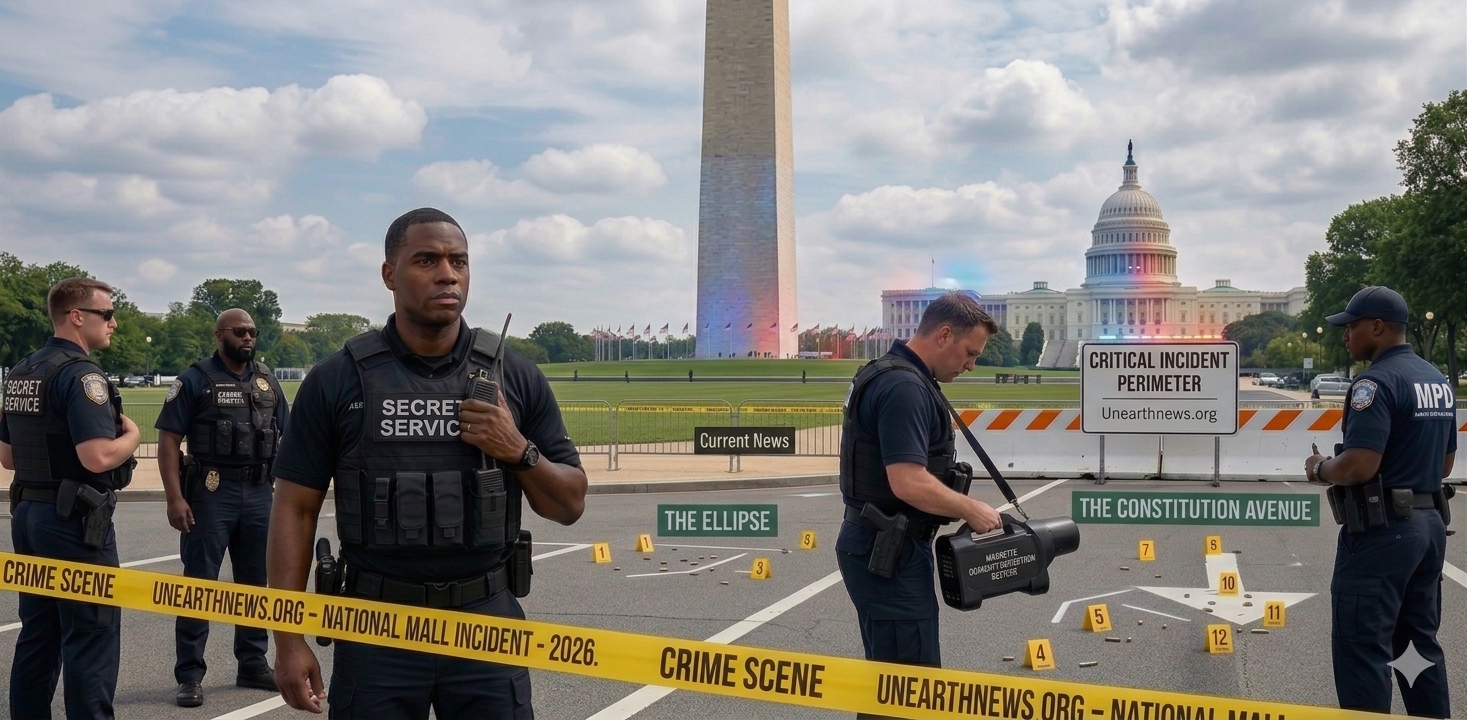
Federal Charges Filed Against Texas Man Following Shooting Incident Near National Mall
The security landscape of Washington, D.C., was thrust into the spotlight this week following a violent confrontation near the National Mall, resulting in serious federal charges against a 45-year-old Texas resident. Michael Marx now faces a multi-count indictment, most notably including the assault of federal officers with a dangerous weapon. The incident, which occurred in one of the most heavily surveilled and culturally significant areas of the United States, underscores the persistent risks faced by law enforcement personnel tasked with protecting the nation’s capital and its high-ranking officials.
According to preliminary investigative reports and court documents, the confrontation began when Marx allegedly discharged a firearm in the vicinity of Secret Service agents who were performing their protective duties. The rapid escalation from a routine patrol or stationary post to a life-threatening engagement highlights the volatile nature of security work in the current socio-political climate. While the agents involved were able to secure the scene without suffering fatal injuries, the psychological and operational impact of such a brazen attack within the federal enclave cannot be overstated.
The legal consequences for Marx are expected to be severe, as the federal government typically pursues maximum sentencing for crimes involving the targeting of law enforcement. Charging a suspect with assaulting a federal officer with a dangerous weapon carries significant mandatory minimums and serves as a deterrent against further acts of political or random violence. This case will likely be handled by the U.S. Attorney’s Office for the District of Columbia, focusing on the intent behind the discharge of the weapon and the potential risk Marx posed to the public at large.
Analyzing the suspect’s background, investigators are looking into why a resident from Texas traveled to the capital with a firearm. This geographical displacement often signals a premeditated intent or a specific grievance against federal institutions. The cause-and-effect relationship here is clear: the arrival of an armed individual with unresolved grievances in a high-security zone inevitably leads to a high-stakes kinetic response from the Secret Service, whose mandate is to neutralize threats immediately to ensure the continuity of government operations.
The National Mall serves as the “front yard” of American democracy, making any breach of peace in this area a matter of national security concern. The incident has prompted an immediate review of security perimeters and patrol frequencies around the monuments and federal buildings. In the wake of this shooting, there is an increased emphasis on identifying “lone wolf” actors who may not be part of a larger organized group but possess the means and motivation to disrupt the peace in the heart of the district.
Furthermore, the incident sheds light on the evolving threat environment that the Secret Service must navigate. Beyond protecting the President and Vice President, the agency is responsible for the integrity of the White House complex and adjacent federal lands. When an individual like Marx engages agents directly, it forces a re-evaluation of the “outer perimeter” strategy, where threats are ideally identified and intercepted blocks away from sensitive sites before a weapon can even be drawn.
From a judicial perspective, the case against Marx will rely heavily on forensic evidence, including shell casings, ballistic reports, and the extensive network of closed-circuit television (CCTV) cameras that blanket the National Mall. The cause of the shooting—whether it was a mental health crisis, a targeted political statement, or a random act of aggression—will dictate the defense’s strategy. However, the effect remains the same: a heightened state of alert for all federal agencies operating in the D.C. metropolitan area.
There is also a broader societal implication regarding the proliferation of firearms and their use in high-profile locations. This event contributes to a growing narrative of insecurity in public spaces, potentially impacting tourism and the openness of the National Mall. If citizens and visitors perceive the capital as a site of frequent violent outbursts, the cultural and economic value of the area could diminish, leading to even more restrictive security measures that distance the public from their government institutions.
The cooperation between the Metropolitan Police Department and federal agencies during the apprehension of Marx demonstrates a refined inter-agency communication protocol. The efficiency with which the suspect was taken into custody without further loss of life suggests that training exercises regarding active shooter scenarios are being effectively translated into real-world applications. This seamless coordination is the primary defense mechanism against the unpredictable nature of individual-led attacks in urban environments.
As the legal process moves forward, Marx will undergo a series of evaluations to determine his competency and the specific motivations for his actions. Federal prosecutors will likely emphasize the proximity of the shooting to sensitive landmarks to argue for high bail or pretrial detention, citing the suspect as a flight risk and a danger to the community. The outcome of this trial will be closely watched by law enforcement advocacy groups as a benchmark for how the justice system protects those on the front lines of federal security.
The incident also highlights the necessity for advanced threat detection technologies. In a world where physical barriers are sometimes insufficient, the use of AI-driven surveillance and acoustic gunshot detection systems becomes vital. The effect of implementing such technology is the reduction in response time, which in this specific case, likely prevented the situation from escalating into a mass casualty event or a prolonged standoff in a public park.
In conclusion, the charging of Michael Marx is not merely a local criminal matter but a significant event that reflects the broader tensions and security challenges facing the United States today. The intersection of individual volatility, firearm accessibility, and the symbolic importance of federal landmarks creates a complex environment for the Secret Service. Moving forward, the focus will remain on balancing public access to the National Mall with the absolute necessity of protecting federal officers from those who would use violence to express their grievances.