
THE SILENT REVOLUTION IN THE STARLIGHT
Imagine for a moment that you are standing in the middle of a vast, dark library that stretches forever in every direction. The shelves are packed with millions of books, but there is a catch: every single one is written in a code so subtle that a human eye could spend a lifetime reading a single page and still miss the secret message hidden in the punctuation.
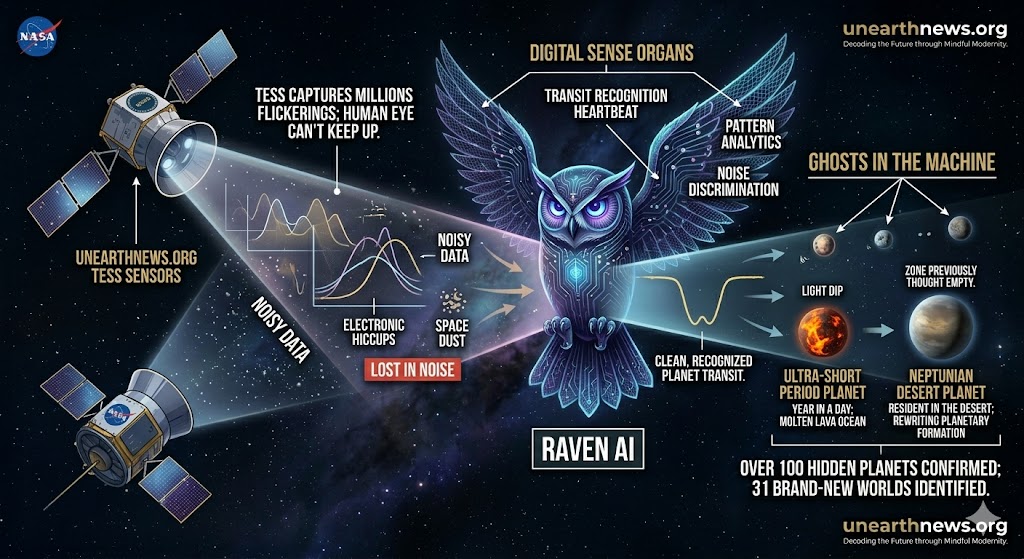
For years, this has been the reality for astronomers working with NASA’s Transiting Exoplanet Survey Satellite, or TESS. TESS is a space telescope that has been staring at the sky, capturing the flickers of millions of stars. It was looking for planets, but it collected so much information that the human brain—and even our standard computers—simply couldn’t keep up. The data was a cosmic haystack, and we knew there were needles inside, but we were trying to find them with our bare hands.
That changed this month. A new artificial intelligence tool named RAVEN has just finished its first major “read” of that library. The results are nothing short of breathtaking. This digital detective has confirmed over 100 hidden planets that we previously missed, including 31 brand-new worlds that no human had ever identified. From “year-in-a-day” planets to worlds that shouldn’t technically exist, RAVEN has proved that the universe is far more crowded, and far stranger, than we ever dared to dream.
THE GHOSTS IN THE MACHINE
To understand how RAVEN found these worlds, we have to look at how we find planets in the first place. Most of the time, we don’t actually “see” a planet through a telescope. They are too small and too far away, drowned out by the blinding glare of their parent stars. Instead, we look for a “transit.”
Think of a transit like a tiny moth flying in front of a bright streetlamp. You can’t see the moth, but you see the light of the lamp dim for a split second as the moth passes by. When a planet crosses in front of its star, the star’s light dips by a tiny fraction of a percent.
The problem is that space is noisy. Stars flicker on their own. Space dust passes by. The telescope itself might have a tiny electronic hiccup. For a human scientist, distinguishing a real planet from “noise” in the data is an exhausting, soul-crushing game of “spot the difference.”
RAVEN, however, doesn’t get tired. It was trained to recognize the specific “heartbeat” of a planet’s transit. By analyzing millions of stars simultaneously, it could see patterns that were too faint for us to notice. It found the “ghosts” in the data—planets that had been sitting on NASA’s servers for years, hidden in plain sight.
THE FORBIDDEN WORLDS AND THE NEPTUNIAN DESERT
Among these 100+ discoveries, a few stand out as true rebels of physics. One of the most exciting finds involves what astronomers call “Ultra-Short Period” planets.
On Earth, it takes 365 days to go around the sun. On these extreme worlds, a “year” lasts less than 24 hours. Imagine a world where you could celebrate your birthday every single morning before you’ve even finished your first cup of coffee. These planets are hugged so tightly by their stars that their surfaces are likely oceans of molten lava, whipped by winds that move faster than sound.
But perhaps the most mysterious discovery is the presence of planets in the “Neptunian Desert.” For a long time, scientists noticed a strange gap in the universe. We found big gas giants (like Jupiter) close to stars, and small rocky planets (like Earth) close to stars. But we almost never found medium-sized planets, like Neptune, in that close-range zone. It was as if that region of space was a desert where Neptune-sized worlds simply evaporated.
RAVEN has found residents in this desert. This discovery is a massive “So What?” for science because it forces us to rewrite our instruction manual for how solar systems form. If these planets can survive in the desert, it means our understanding of planetary atmospheres—and how they resist being stripped away by solar heat—is incomplete. We are learning that nature is much more resilient than we gave it credit for.
WHY THIS MATTERS TO YOU IN 2026
It is easy to look at a discovery about a lava-world trillions of miles away and think, “That’s neat, but I have bills to pay.” However, the success of RAVEN represents a fundamental shift in how we live alongside technology.
We are entering an era where AI is no longer just a tool for writing emails or generating art; it has become a “sense organ” for humanity. It is allowing us to see things that our biological eyes were never meant to perceive. The same logic RAVEN uses to find a planet in a sea of starlight is being adapted to find early-stage cancers in medical scans or to predict weird weather patterns before they happen.
Beyond the technology, these 100 new planets change our perspective on “home.” Every time we find a new world, the mathematical probability that we are alone in the universe shrinks. In 2026, as we deal with global challenges and the feeling that our world is getting smaller, these discoveries remind us that we are part of a vast, vibrant, and largely unexplored neighborhood. It turns the night sky from a dark void into a map of possibilities.
CONNECTING THE COSMIC TO THE COMMONPLACE
There is a profound peace that comes from “Mindful Modernity”—the practice of using our high-tech tools to foster a deeper connection to the natural world. RAVEN is a product of the digital age, but its entire purpose is to help us understand the ancient, physical universe.
When you walk outside tonight and look up, you aren’t just looking at random points of light. Thanks to this discovery, you can know for a fact that those stars are almost certainly hosts to families of planets. Some are frozen wastes, some are molten hellscapes, and some might be just right.
This realization encourages a kind of “cosmic humility.” It reminds us that while our daily stresses feel all-consuming, we are living on a tiny, precious blue marble in a galaxy teeming with diversity. Understanding the “extreme” worlds—the ones in the Neptunian desert or the ones that orbit in a day—makes us appreciate the stability and balance of our own Earth even more. We live in the “Goldilocks zone” not just by chance, but as part of a grand, complex celestial mechanics that we are finally beginning to decode.
THE BEGINNING OF THE VOYAGE
The 100 planets found by RAVEN are just the beginning. There are thousands more “candidates” waiting in the wings, and millions of stars still left to scan. We are currently in the middle of the greatest era of discovery in human history, surpassing even the age of the great ocean explorers.
The “New World” isn’t across an ocean anymore; it’s across the light-years. And we don’t need wooden ships to get there; we need curiosity, better sensors, and the brilliant digital minds we are building to help us see the way.
As RAVEN continues its work, we should expect the “impossible” to become the “confirmed.” We are peeling back the layers of the universe, one flicker of starlight at a time. And as we find more of these rare and extreme worlds, we get closer to answering the biggest question of all: Is there anyone else out there looking back at us, wondering the same thing?
For now, we can take comfort in the fact that the library of the stars is finally being read. The secrets are coming to light, and the neighborhood is looking much more crowded than it did yesterday. The next time you look up, remember: the sky isn’t empty. It’s waiting for us to notice it.