
THE FACE THAT TIME FORGOT
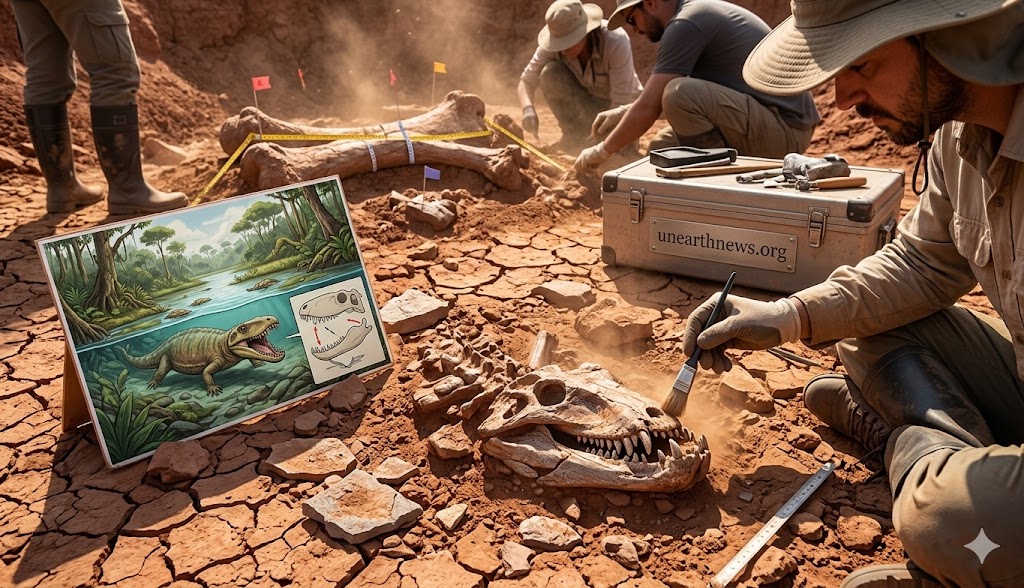
Imagine walking along a cracked, sun-bleached riverbed in northeastern Brazil. The heat is a physical weight on your shoulders, and the ground beneath your boots is a mosaic of parched red clay. You stoop down to pick up what looks like a fragment of stone, but as you brush away the dust of 275 million years, you realize you are looking at a face. But it is a face that makes no sense. The jaw is skewed, twisted to one side like a piece of wet clay that was nudged before it could dry.
This is not a fossil of a creature that was born broken. This was a predator that thrived, a biological rebel that ignored the rules of symmetry that govern almost every animal on Earth today. This is Tanyka amnicola, and its discovery is rewriting what we thought we knew about the survivors of our planet’s deep past.
THE DISCOVERY: A GLITCH IN THE TIMELINE
When a team of paleontologists uncovered the remains of Tanyka in the Parnaíba Basin of Brazil, they knew they had found something special, but they didn’t immediately realize they had found a ghost. To understand why Tanyka is so strange, we have to look at the world it lived in.
Two hundred and seventy-five million years ago, the world was a very different place. This was the Permian period, a time long before the first dinosaur ever took its first breath. South America was not an isolated continent but part of the massive supercontinent Pangaea. The area where Tanyka was found was once a lush, freshwater system, a network of rivers and ponds teeming with life.
Tanyka belonged to a group called dvinosaurian temnospondyls. To make that simpler, imagine a creature that looks like a cross between a giant, armored salamander and a crocodile. These were some of the top predators of their day, lurking in the shallows and snapping at anything that swam too close.
But here is the twist—literally. By the time Tanyka was swimming in those Brazilian rivers, its lineage was supposed to be long gone from that part of the world. Scientists call this a living fossil. It is like walking into a modern city and finding someone driving a perfectly functional horse and carriage through a sea of electric cars. Tanyka was an ancient relic that refused to go extinct, thriving in a pocket of the world long after its cousins had vanished elsewhere.
THE MYSTERY: THE BEAUTY OF BEING ASYMMETRICAL
The most jarring thing about Tanyka is its jaw. In the animal kingdom, symmetry is usually the gold standard. Your left arm matches your right; a hawk’s left wing is a mirror image of its right. This balance helps with movement, balance, and hunting. But Tanyka’s jaw was significantly asymmetrical. One side was shorter and more twisted than the other.
In a modern laboratory, if you saw a bone like this, you might think the animal had suffered a terrible injury or a birth defect. But as the researchers looked closer at the fossils, they realized this wasn’t a mistake. It was a design.
Think of Tanyka’s jaw like a specialized tool. Have you ever tried to use a pair of standard scissors with your left hand? They don’t cut quite right because the blades aren’t aligned for that angle. But if you have a pair of specialized, offset snips, you can cut through heavy wire with ease. Scientists believe Tanyka’s twisted jaw might have worked in a similar way.
This creature lived in a world of slippery, fast-moving prey. In the murky waters of an ancient river, you don’t get a second chance to grab a meal. That twisted jaw might have allowed Tanyka to snap shut with a unique shearing force, acting like a biological trap that was impossible to escape from. It was a specialized solution to a very specific problem. It teaches us that evolution doesn’t always strive for “perfection” in the way we define it; it strives for “whatever works.”
IMPACT ON US: THE SURVIVOR’S BLUEPRINT
Why does a twisted jaw from the Permian period matter to us in 2026? It matters because we are currently living through a period of massive environmental change. We often talk about extinction as a sudden, final door slamming shut. We look at the dinosaurs and see a fireball from the sky. But Tanyka tells a different story—a story of resilience.
Tanyka shows us that life is incredibly good at finding “refugia,” or safe havens. When the rest of the world was changing and their relatives were dying out, these creatures found a specific environment in Brazil that allowed them to persist for millions of extra years.
For us today, this discovery is a reminder that the map of life is much more complex than a simple timeline of “old things replaced by new things.” It suggests that even in our current era of climate crisis and habitat loss, there are “biological pockets” that hold the secrets to survival. By studying how Tanyka survived against the odds, we learn about the flexibility of life. We learn that being “weird” or “different”—like having a twisted jaw—isn’t a weakness. Often, it is the very thing that allows a species to endure when everyone else is disappearing.
MINDFUL MODERNITY: EMBRACING THE OUTLIERS
There is a profound lesson in the red dust of Brazil for how we live our lives today. We live in a world that is obsessed with optimization and symmetry. We want our technology to be sleek, our schedules to be balanced, and our lives to look perfectly aligned on a screen.
But nature is messy. Tanyka amnicola was a successful, thriving predator precisely because it wasn’t symmetrical. It was an outlier.
When we look at the natural world, we should see it not as a collection of perfect specimens, but as a vast, ancient laboratory of experiments. Some of those experiments look like us, and some look like twisted-jawed salamander-crocodiles. When we protect a local wetland or a small patch of forest, we aren’t just saving a few trees or frogs; we are protecting a potential safe haven for the Tanykas of the future.
Connecting with nature in 2026 means recognizing that diversity is our greatest insurance policy. The more “weird” things we have in the world, the more likely it is that something will survive the next big shift. Tanyka invites us to be more mindful of the outliers in our own ecosystems and our own societies. The things that don’t seem to fit the current mold might be the very things that carry the torch of life into the next era.
A POETIC BUT GROUNDED CONCLUSION
The river that Tanyka amnicola once called home has been dry for hundreds of millions of years. The water is gone, the lush greenery has turned to stone, and the supercontinent of Pangaea has drifted apart into the world we recognize on a map today.
Yet, there is something deeply comforting about the discovery of this animal. It reminds us that the Earth has a long memory. It reminds us that life is persistent, stubborn, and wonderfully strange.
Tanyka didn’t care that it was a “living fossil.” It didn’t know its jaw was “wrong” by the standards of other animals. It simply existed, snapping at fish in the Brazilian sun, a master of its own small corner of time. As we look forward to our own future, we can take a page from this ancient survivor’s book. We don’t have to be perfect to survive; we just have to be adaptable. We have to find our own “refugia,” embrace our own unique “twists,” and keep swimming, even when the rest of the world thinks our time has passed.
In the end, we are all just travelers through time, looking for a way to leave a mark in the riverbed before the water runs dry. Tanyka left its mark—a beautiful, twisted, 275-million-year-old smile.