
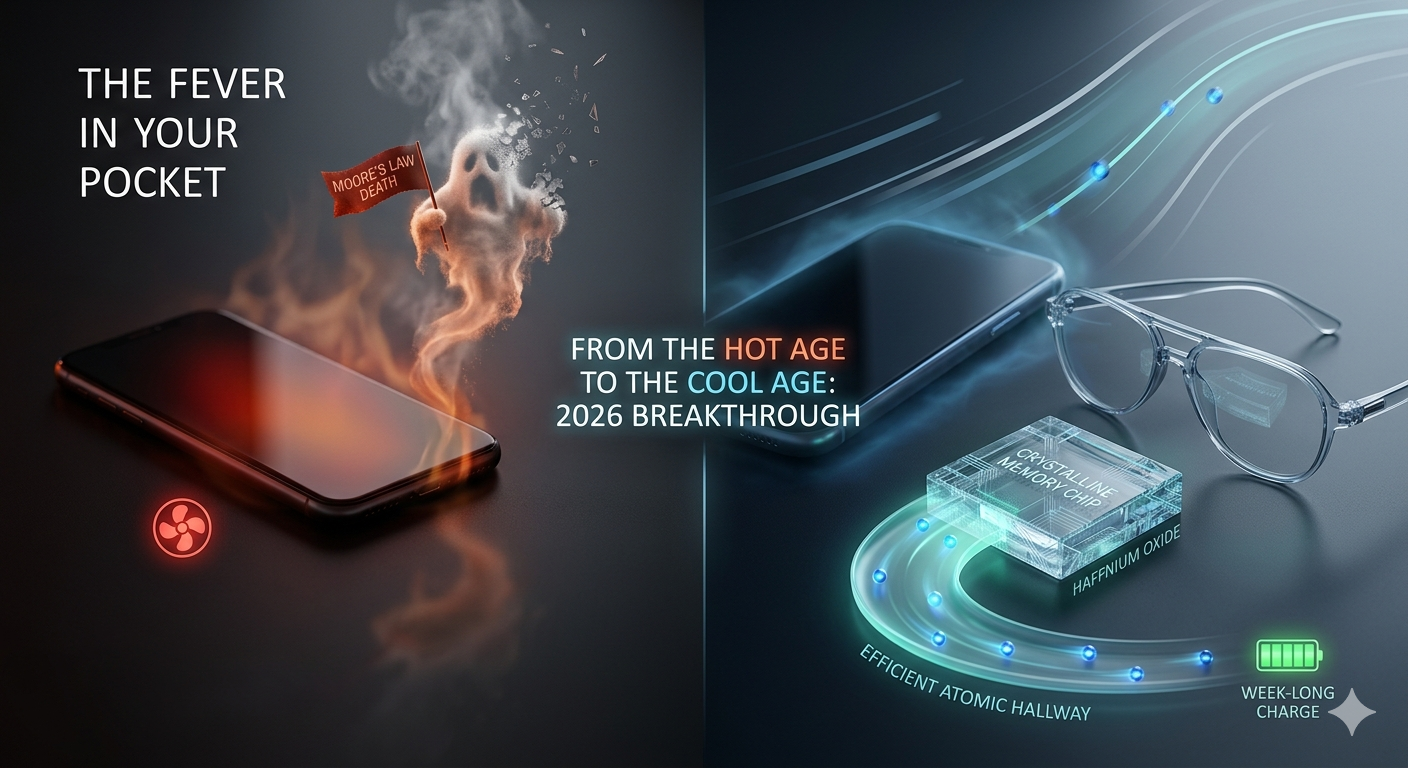
The Fever in Your Pocket
You have likely felt it before—that creeping warmth against your palm when you have been scrolling too long or that sudden heat on your thigh when your phone is processing a large update in your pocket. That heat is the silent ghost of wasted energy. For decades, we have lived in a world where “more power” meant “more heat.” We have shrunk our technology down to the point where the components are nearly the size of a single strand of DNA, but we hit a wall. In the world of traditional electronics, when things get smaller, they usually get angrier. They leak energy, they overheat, and they drain our batteries in a desperate attempt to keep up with our demands.
For a long time, scientists feared we were reaching the end of what was physically possible. They called it the death of Moores Law—the famous observation that the number of transistors on a chip doubles every two years. We were running out of room, and more importantly, we were running out of ways to keep things cool. But a team of researchers has just done something that sounds like a glitch in the laws of physics. They have built a memory chip that actually gets better, cooler, and more efficient as it shrinks. They haven’t just moved the goalposts; they have changed the game entirely.
The Mystery of the Shrinking Efficiency
To understand why this is such a shock to the system, think about a crowded hallway. If you want to move a thousand people through a wide corridor, they can walk comfortably. But if you shrink that corridor down to the width of a crawlspace while trying to push the same number of people through, everyone starts bumping into each other. That friction creates heat. In your current smartphone, the electrons—the tiny particles of electricity—are like those people. As the wires get thinner and the components get smaller, those electrons bump into everything, losing energy as heat. This is why your laptop needs a loud fan and why data centers use millions of gallons of water just to stay cool.
The researchers behind this new memory device decided to stop trying to force the electrons through the same old hallways. Instead, they redesigned the very structure of the material at an atomic level. They created a tiny memory unit that uses a specialized crystalline structure.
Instead of electricity fighting against the walls of the device, the new design allows the information to flip and store itself with almost zero resistance. In the strange world of the ultra-small, they found that when they reached an extreme scale, the energy loss didn’t just level off—it started to drop. It is as if that crowded hallway suddenly turned into a high-speed slide where the narrower the slide gets, the faster and smoother you go. They have broken the rule of miniaturization, proving that we can have smaller devices that are actually more powerful and more composed than the giants that came before them.
A Day in the Life of 2026
Why does this matter to you? Imagine it is a Tuesday morning in the year 2026. You wake up and put on a pair of glasses that project your schedule onto the air in front of you. Normally, a device like that would require a bulky battery or would get uncomfortably hot against your temple within minutes. But because of this new memory technology, the glasses are as light as a standard pair of aviators. They process complex information locally, right on the frame, without needing to send data back and forth to a massive, energy-hungry server in the desert.
Consider your smartphone. In this new era, the “low battery” warning becomes a distant memory. Because the memory chips inside are no longer bleeding energy as heat, your phone might last a week on a single charge. This discovery paves the way for what engineers call “ambient computing”—technology that is so efficient it can run on the tiny bits of energy it harvests from the environment around it, like the warmth of your skin or the vibrations of your footsteps.
This is especially revolutionary for Artificial Intelligence. Right now, AI is a power hog. When you ask a digital assistant a complex question, a massive warehouse of computers somewhere in the world has to hum to life, consuming enough electricity to power a small town. With memory that improves as it shrinks, we can put the brain of an AI directly into your watch or your hearing aid. It makes technology faster, more private, and infinitely more accessible.
The Quiet Revolution of Mindful Modernity
Beyond the convenience of a long-lasting phone, there is a deeper, more profound impact on our relationship with the planet. We often think of the digital world as weightless and invisible—the “Cloud.” But the reality is that the Cloud is made of steel, plastic, and an immense amount of electricity. Every video we stream and every file we save contributes to a global energy demand that is becoming unsustainable.
By creating hardware that is fundamentally more efficient, we are moving toward a more mindful version of modernity. We are learning how to do more with less. In nature, the most complex systems are often the most efficient. Think of the human brain: it is the most powerful computer in the known universe, yet it runs on about twenty watts of power—barely enough to light a dim bulb. This new memory chip is a step toward that biological gold standard. It suggests a future where our technology doesnt have to be a loud, hot, power-hungry intruder in our lives. Instead, it can be as quiet and efficient as a leaf photosynthesizing in the sun.
This discovery allows us to reconnect with our environment. When our devices dont need to be tethered to a wall outlet every few hours, we are free to move. When our data centers dont require the damming of rivers for cooling, our natural landscapes can remain untouched. It is a shift from a “brute force” era of technology to an “elegant” one.
The Beauty of the Small
We often fall into the trap of thinking that bigger is better or that progress must always come with a cost. We have accepted that our tech will always be fragile and power-thirsty. But every once in a while, a discovery comes along that reminds us that the universe has hidden hallways we haven’t explored yet.
The scientists who built this chip looked at a wall and saw a doorway. They proved that as we descend into the microscopic world, the rules we thought were absolute are actually flexible. This tiny piece of memory is more than just a component for a faster phone; it is a testament to human curiosity and our ability to harmonize with the laws of physics rather than fighting against them.
As we move forward, we will likely look back on the early twenty-first century as the “Hot Age”—a time when our pockets were warm and our fans were loud. We are standing on the threshold of the “Cool Age,” where technology finally learns to whisper. The future is getting smaller, and for the first time in history, that means it is getting better. We are finally learning that the secret to true power isn’t in how much energy you can consume, but in how little you can waste.