
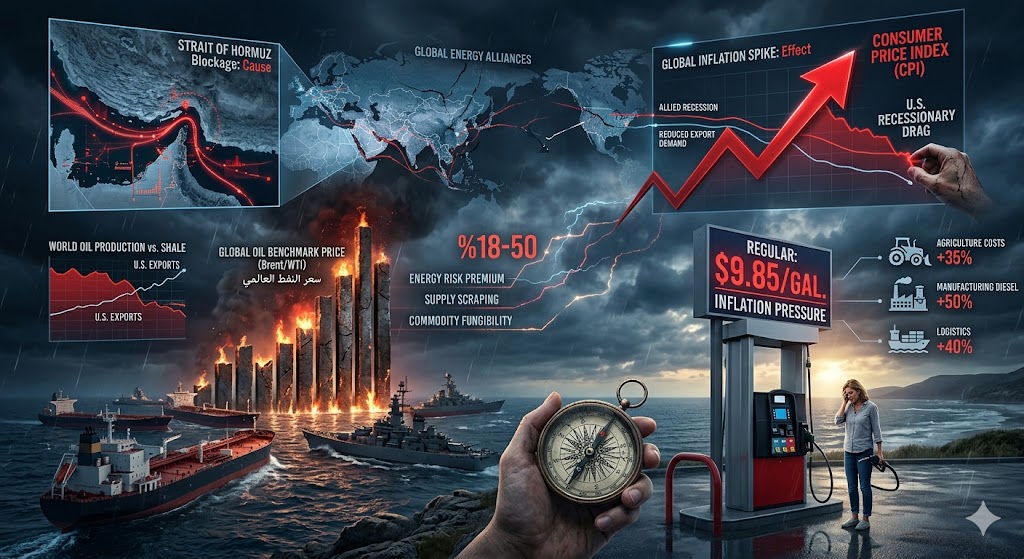
The geopolitical tension surrounding the Persian Gulf has long served as a primary driver of global energy market volatility, yet recent political discourse has frequently attempted to minimize the potential economic fallout of a conflict with Iran. When evaluating the impact of regional instability, specifically regarding the Strait of Hormuz, it is essential to understand that the global oil market operates as a singular, interconnected system. Even as the United States has increased domestic production to become a net exporter of petroleum products, the pricing of these commodities remains tethered to international benchmarks. Consequently, any significant disruption in the Middle East does not merely affect regional players; it exerts immediate upward pressure on global prices, which translates directly to higher costs for American consumers at the pump.
The Strait of Hormuz remains the world’s most critical oil transit chokepoint, with approximately one-fifth of the world’s total oil consumption passing through this narrow waterway daily. Political claims suggesting that the United States is now insulated from such disruptions due to domestic shale production overlook the fundamental principles of commodity fungibility. If a conflict were to impede the flow of oil through the Strait, the global supply-demand balance would be catastrophically upended. This scarcity would trigger a competitive bidding environment among international buyers, driving the price per barrel to historic highs, regardless of whether the crude oil was sourced from West Texas or the Arabian Peninsula.
The relationship between energy costs and broader economic inflation is both direct and multi-faceted. When gas prices soar, the immediate effect is a reduction in discretionary consumer spending, as a larger portion of household income is diverted to essential transportation. However, the secondary effects are often more insidious and long-lasting. Energy is a primary input for almost every sector of the modern economy, from the fuel required for agricultural machinery to the electricity used in manufacturing and the diesel needed for logistics and shipping. As these operational costs rise, businesses inevitably pass the burden onto consumers, leading to a general increase in the price of goods and services across the board.
Furthermore, the psychological impact of a conflict in the Middle East often induces a “risk premium” in the markets long before a single drop of oil is actually lost. Speculators and institutional investors react to the threat of instability by hedging their positions, which drives prices upward in anticipation of a supply crunch. This proactive market behavior can sustain high inflation rates even if the physical supply remains relatively stable, as the mere perception of risk becomes a self-fulfilling prophecy for higher energy costs. Minimizing this risk in political rhetoric fails to account for the sophisticated and often reactive nature of global financial markets.
The notion that the American economy’s need for the Strait of Hormuz has diminished also ignores the strategic importance of liquefied natural gas (LNG). In recent years, Qatar has emerged as a leading exporter of LNG, much of which passes through the Strait to reach global markets. A disruption in this flow would not only spike oil prices but would also cause a massive surge in natural gas prices. This would have a devastating impact on global manufacturing and heating costs, particularly in Europe and Asia, which in turn would dampen global economic growth and reduce demand for American exports, creating a recessionary drag on the domestic economy.
Domestic oil refineries in the United States are also a critical factor often omitted from the conversation. Many refineries along the Gulf Coast are specifically configured to process the “heavy” and “medium” grades of crude oil that are typically imported from the Middle East and South America, rather than the “light, sweet” crude produced by American shale plays. If Middle Eastern supplies were cut off, these refineries would face significant operational challenges and increased costs to source alternative feedstocks. This technical mismatch ensures that the U.S. remains fundamentally reliant on global supply chains, despite the high volume of domestic extraction.
Historically, energy shocks have been the primary catalyst for some of the most challenging economic periods in modern American history. The oil embargoes of the 1970s demonstrated how a sudden reduction in supply can lead to “stagflation”—a period of stagnant economic growth coupled with high inflation. While the modern economy is more energy-efficient than it was five decades ago, the core vulnerability remains. A sustained spike in oil prices resulting from an Iranian conflict would likely force the Federal Reserve to maintain or even increase interest rates to combat inflation, further cooling economic activity and increasing the cost of borrowing for American families and businesses.
The strategic petroleum reserve (SPR) is frequently cited as a safeguard against such disruptions, yet its capacity is finite and intended for short-term emergencies rather than prolonged geopolitical conflicts. Utilizing the SPR can provide temporary relief, but it does not address the underlying structural deficit created by a major chokepoint closure. Moreover, the process of refilling the reserve after a crisis often keeps oil prices elevated for an extended period, as the government becomes a major purchaser in a recovering market. Therefore, relying on the SPR as a primary defense against the economic consequences of war is a short-term solution to a long-term strategic problem.
International alliances also complicate the “energy independence” narrative. The United States’ key economic partners in Europe and Asia are significantly more dependent on Middle Eastern energy than North America is. In the event of a blockade or conflict, these allies would experience severe economic contractions. Because the global economy is deeply integrated, a recession in the Eurozone or a slowdown in major Asian economies would inevitably hurt American multinational corporations and financial institutions, demonstrating that the U.S. cannot “decouple” its economic health from the stability of the Persian Gulf.
Looking toward the future, the transition to renewable energy sources may eventually reduce the global economy’s sensitivity to oil price shocks, but that transition is not yet complete. For the foreseeable future, the global transport and logistics infrastructure remains overwhelmingly dependent on petroleum-based fuels. Until alternative technologies achieve full-scale market penetration, the price of oil will continue to be the most influential factor in determining global inflationary trends and consumer confidence. Downplaying this reality ignores the current material constraints of the global energy landscape.
Ultimately, the claim that the United States is immune to the economic shocks of a Middle Eastern war is not supported by the data of global trade or the mechanics of energy pricing. The cause-and-effect chain is clear: conflict leads to supply uncertainty, which triggers price spikes in global benchmarks, which in turn drives up domestic fuel prices and fuels broader inflationary pressure. This sequence of events has the potential to destabilize the American economy, regardless of the level of domestic oil production. Accurate economic analysis must account for these global interdependencies rather than relying on a localized view of energy production.
In conclusion, the strategic importance of the Strait of Hormuz and the stability of the Persian Gulf remain paramount to the economic security of the United States. While political messaging may attempt to soothe public concerns regarding gas prices and inflation, the underlying economic realities suggest that any significant conflict in the region would have profound and painful consequences for the American public. A deep-dive into market dynamics reveals that energy independence is a relative term, and in a globalized world, the ripple effects of a regional war would be felt in every corner of the domestic marketplace.