
The Fetterman Paradox: Analyzing the Strategic Recalibration of Pennsylvania’s Junior Senator
Senator John Fetterman’s recent public declarations regarding his status within the Democratic Party represent a significant moment of internal recalibration for a political organization often struggling to balance its progressive and moderate wings. In a comprehensive op-ed published in The Washington Post, the Pennsylvania senator addressed growing speculation about his political future, firmly stating that he has no intention of defecting to another party or becoming an independent. This announcement serves as a calculated response to months of increasing friction between Fetterman and the further-left elements of his constituency, positioning him as a distinct, if sometimes discordant, voice within the modern Democratic framework.
The catalyst for this clarification stems from a series of high-profile breaks with party orthodoxy, particularly regarding the conflict in the Middle East and domestic border security. Fetterman has long been viewed as a standard-bearer for working-class populism, but his recent alignment with more traditional, and at times hawkish, foreign policy positions has sparked intense debate among his supporters. By choosing to voice his loyalty to the party through a major national publication, Fetterman is attempting to frame his disagreements not as a sign of impending departure, but as a healthy manifestation of a “big tent” political organization that must accommodate diverse viewpoints to remain viable in battleground states.
Central to Fetterman’s argument is the rejection of the “progressive” label, a term he once embraced but now views as having shifted away from his core values. He contends that while the political landscape and the definitions of certain ideological movements have migrated, his own principles remain static. This distinction is critical because it highlights a growing divide in the Democratic Party between those who prioritize social and cultural progressivism and those who focus on economic populism and institutional stability. By distancing himself from the “progressive” brand while remaining a Democrat, Fetterman is effectively attempting to carve out a new space for pragmatic, blue-collar advocacy that prioritizes local interests over national ideological purity.
One of the primary cause-and-effect relationships driving this narrative is Fetterman’s staunch support for Israel following the October 7 attacks. This position has created a rift with the younger, more activist wing of the party, which has increasingly called for a ceasefire and a reassessment of the U.S.-Israel relationship. The effect of Fetterman’s unwavering stance has been two-fold: it has alienated a segment of his base that was instrumental in his 2022 victory, but it has simultaneously bolstered his appeal among moderate and independent voters in Pennsylvania. This strategic pivot suggests that Fetterman is looking beyond the immediate noise of social media activism toward the long-term electoral realities of a quintessential purple state.
Furthermore, Fetterman’s rhetoric regarding the U.S.-Mexico border has signaled a departure from recent Democratic messaging. By acknowledging the severity of the border crisis and calling for more robust enforcement measures, he has aligned himself with a sentiment that is often more prevalent in Republican circles. The cause of this shift appears to be a realization that immigration is a top-tier concern for Pennsylvania voters across the political spectrum. Consequently, Fetterman’s willingness to break ranks on this issue serves to insulate him from GOP attacks while forcing his own party to confront the complexities of border management ahead of critical election cycles.
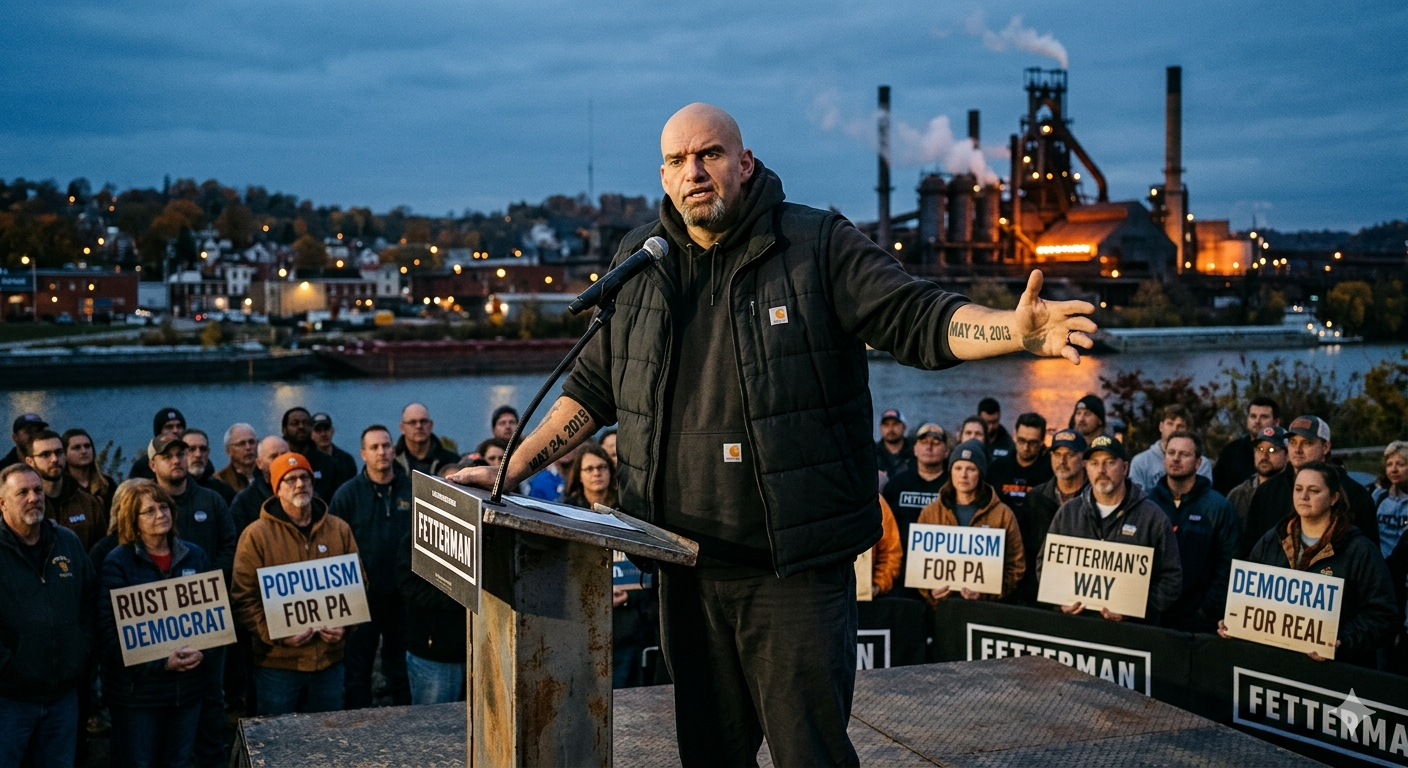
The analytical depth of Fetterman’s current positioning reveals a sophisticated understanding of the “Rust Belt” political ecosystem. Pennsylvania is a state where elections are won on the margins, and Fetterman’s blue-collar aesthetic and plain-spoken delivery are designed to resonate in areas where traditional Democratic messaging often fails. By asserting that he has “no plans” to leave the party, he is essentially telling the national Democratic leadership that his brand of politics—one that incorporates elements of traditionalism and security—is the most effective way to retain power in the American heartland. His stance serves as a warning that the party cannot afford to ignore the pragmatic concerns of its working-class members in favor of ivory-tower idealism.
From a broader perspective, Fetterman’s op-ed addresses the concept of institutional loyalty in an era of hyper-partisanship. Many observers had speculated that Fetterman might follow the path of Senator Kyrsten Sinema or Senator Joe Manchin by declaring independence. However, Fetterman’s decision to remain a Democrat suggests a different strategic calculus. He likely recognizes that the Democratic Party remains the only viable vehicle for his legislative goals, and that his influence is greater as a dissenting voice within the majority than as an isolated independent. This decision maintains his access to committee assignments and party resources while allowing him the freedom to act as an internal critic.
The implications for the 2024 general election are profound. As President Biden seeks re-election, he requires a coalition that includes both the progressive base and the moderate middle. Fetterman’s current trajectory provides a template for how a Democrat can appeal to the latter without officially abandoning the former. If Fetterman can successfully navigate this ideological middle ground, he may serve as a crucial bridge for the Biden campaign in Pennsylvania. However, if his heterodoxy continues to inflame the party’s left wing, it could lead to depressed turnout or internal sabotage, illustrating the high-stakes gamble inherent in his political evolution.
Moreover, the reaction to Fetterman’s statements within the Senate itself will be a bellwether for future party unity. His colleagues now face the challenge of integrating a senator who is publicly “at odds” with several key platform planks. The cause of this friction is a fundamental disagreement over the party’s direction, and the effect will be a more complex legislative process where Fetterman’s vote cannot be taken for granted. This unpredictability adds a layer of difficulty for Democratic leadership, but it also provides them with a direct link to the types of voters they risk losing to populist Republican movements.
Ultimately, John Fetterman is attempting to redefine what it means to be a Democrat in the 21st century. His refusal to leave the party, despite his disagreements, is a testament to his belief that the party is large enough to contain his specific brand of Pennsylvania populism. It is a bold assertion that the party’s center of gravity should shift back toward the industrial North and away from the coastal ideological hubs. Whether this strategy will lead to a broader realignment within the party or result in Fetterman’s eventual isolation remains to be seen, but for now, his commitment to the Democratic label is a defining feature of his political identity.
In conclusion, Fetterman’s op-ed is more than a simple clarification of party status; it is a manifesto for a different kind of Democratic politics. By emphasizing that his values have not changed even as he clashes with party leadership, he is challenging the notion that party membership requires total ideological conformity. The future of his career—and perhaps the Democratic Party’s success in the Rust Belt—will depend on whether he can convince his peers that his dissent is not a sign of disloyalty, but a necessary evolution for survival in a polarized and volatile political environment.