
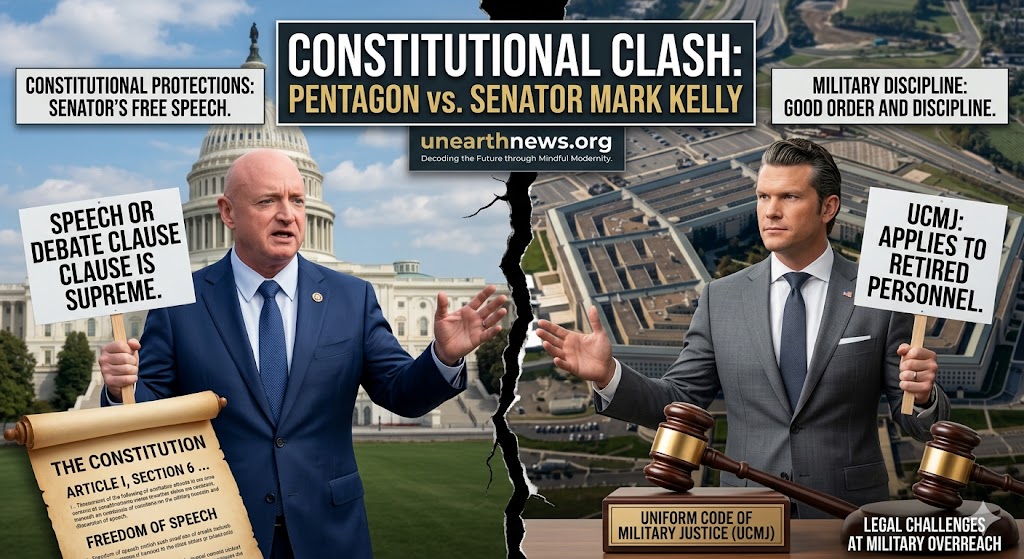
Legal Challenges Mount Against Pentagon Efforts to Discipline Senator Mark Kelly Over Constitutional Speech
A high-stakes legal confrontation reached the federal appeals court in Washington this week as a three-judge panel signaled deep skepticism toward the Department of Defense’s attempts to discipline Senator Mark Kelly. The case centers on a controversial video released by the Senator, in which he cautioned military personnel regarding their ethical and legal obligations to refuse unlawful orders. This judicial scrutiny highlights a burgeoning conflict between executive branch authority over military discipline and the constitutional protections afforded to members of Congress, particularly those with prior military service. The panel’s line of questioning suggested that the government’s pursuit of disciplinary action may infringe upon fundamental separations of power.
The core of the dispute involves a video message where Senator Kelly, a retired Navy captain and astronaut, addressed the sanctity of the military oath. In the recording, Kelly emphasized that the duty of a service member is to the Constitution rather than to any individual leader, specifically warning against the execution of illegal directives. While the Pentagon, under the leadership of Peter Hegseth, argued that such rhetoric undermines good order and discipline within the ranks, the appellate judges appeared more concerned with the potential for executive overreach. The courtroom exchange underscored the tension between maintaining a cohesive chain of command and protecting the right of elected officials to engage in public discourse on matters of national security.
Legal analysts suggest that the Pentagon’s aggressive stance is an attempt to exert control over the narrative of military obedience in an increasingly polarized political climate. By seeking to penalize a sitting Senator, the Department of Defense is testing the limits of the Uniform Code of Military Justice as it applies to retired officers who transition into legislative roles. The government’s argument rests on the premise that Kelly’s status as a retired officer keeps him within the orbit of military jurisdiction, even while serving in the Senate. However, the appellate panel’s reaction indicates that this interpretation may be a bridge too far, potentially threatening the independence of the legislative branch.
The cause-and-effect relationship in this litigation is rooted in the perceived threat that Kelly’s comments pose to the executive’s control over the armed forces. If the Pentagon were successful in disciplining the Senator, it would establish a precedent where the Department of Defense could theoretically silence any veteran in Congress who critiques military policy or executive directives. This potential for a chilling effect on political speech was a recurring theme during the oral arguments. The judges questioned whether the military’s interest in discipline outweighs the public’s interest in hearing from experienced legislators on the nuances of military ethics and the rule of law.
The Speech or Debate Clause of the Constitution serves as a primary shield for Senator Kelly in this instance. This clause is designed to protect members of Congress from executive or judicial interference regarding their legislative duties and public communications. The defense argued that Kelly’s video was a direct extension of his role as a lawmaker and a member of the Senate Armed Services Committee, intended to inform the public and the military community about constitutional boundaries. The appellate judges seemed to weigh this constitutional protection heavily against the Pentagon’s claims of administrative necessity, suggesting that the legislative privilege likely trumps military regulations in this context.
Furthermore, the case raises significant questions about the reach of the Uniform Code of Military Justice over retired personnel. While the Supreme Court has previously upheld the government’s right to court-martial retirees in specific circumstances, applying these rules to a sitting United States Senator for political speech introduces a novel and potentially dangerous legal territory. The panel noted that the transition from active duty to a constitutionally mandated office creates a distinct legal status that cannot be easily subsumed by military law. This distinction is crucial for maintaining the civilian control of the military, a cornerstone of American democracy that the judges seemed intent on preserving.
The political implications of the court’s eventual ruling cannot be overstated. A decision in favor of the Pentagon would grant the executive branch a powerful tool to intimidate veteran-legislators who dissent from administration policy. Conversely, a ruling protecting Kelly would reaffirm the independence of Congress and the broad scope of the Speech or Debate Clause. The panel’s skeptical questioning of the government’s counsel suggests they are wary of the broader ramifications of allowing the military to police the speech of elected officials, regardless of their past military service or current status in the reserves or retirement.
From an analytical perspective, the Pentagon’s move against Kelly appears to be a reactionary measure intended to solidify executive authority over the defense apparatus. However, this strategy may backfire if the court issues a definitive ruling that limits the military’s jurisdiction over retired officers in public office. The judges pointed out that the military must have a compelling reason to infringe upon protected speech, and in this case, the government struggled to demonstrate actual harm to military readiness or order caused by Kelly’s video. The lack of empirical evidence regarding the video’s impact weakened the Pentagon’s justification for disciplinary measures.
This legal battle also highlights the friction between the current administration’s interpretation of executive power and the traditional norms of civil-military relations. Peter Hegseth’s advocacy for strict adherence to the chain of command clashes with the legislative oversight role that Senators like Mark Kelly perform. By attempting to use disciplinary channels to address what is essentially a political and constitutional disagreement, the Pentagon has moved the conflict from the halls of Congress to the federal courts. This shift forces the judiciary to serve as an arbiter in a dispute that touches on the very foundation of how power is balanced between the branches of government.
As the court moves toward a final decision, the focus remains on the preservation of constitutional order. The judges’ skepticism indicates a preference for a narrow interpretation of military authority when it intersects with legislative functions. Should the court rule against the Pentagon, it will serve as a significant check on the executive branch’s ability to use the military justice system as a mechanism for political retribution. This outcome would ensure that veterans who continue to serve their country in the legislative branch can do so without the looming threat of administrative or judicial punishment from the department they once served.
The ultimate resolution of this case will likely set a landmark precedent for the rights of veteran-politicians and the scope of the Speech or Debate Clause in the modern era. It serves as a reminder that while the military operates under a unique set of rules necessary for combat effectiveness, those rules do not exist in a vacuum and are subject to the overarching requirements of the Constitution. The appellate court’s leanings suggest that the principles of free speech and legislative independence will likely prevail over the Pentagon’s desire for absolute narrative control within the military community.
In conclusion, the proceedings before the three-judge panel indicate a significant setback for the efforts to penalize Senator Kelly. The case underscores the essential role of the judiciary in mediating conflicts between the branches of government and ensuring that the pursuit of military discipline does not come at the expense of constitutional liberties. The future implications of this ruling will resonate through the Pentagon and the Capitol for years to come, defining the boundaries of speech for those who have worn the uniform and continue to serve the nation in a civilian capacity.