
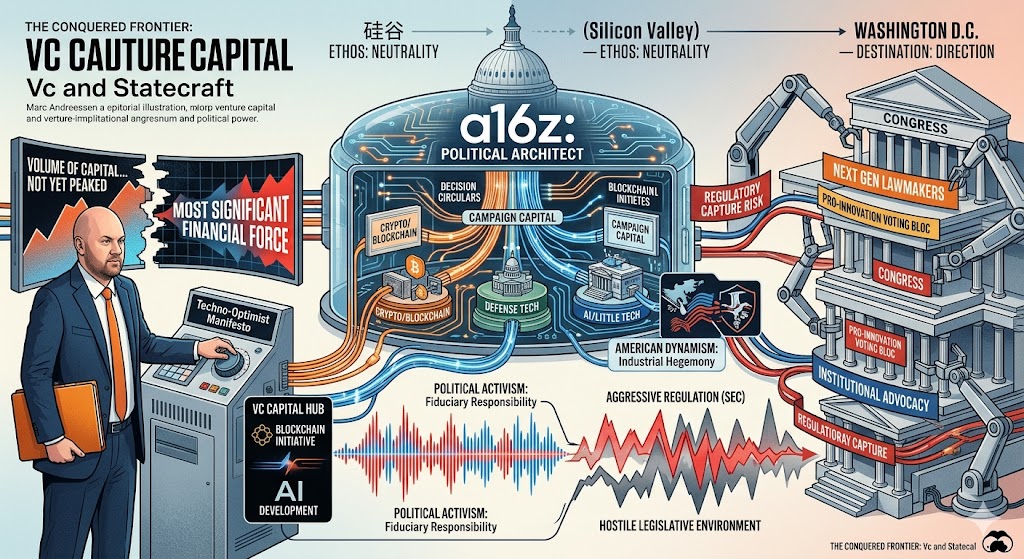
In 2000, Marc Andreessen offered a prophetic warning regarding the future of the American political landscape, suggesting that the volume of capital influencing governance had not yet reached its peak. Decades later, that prediction has manifested in the form of his own venture capital firm, Andreessen Horowitz (a16z), which has emerged as the most significant financial force in the current campaign cycle. This shift represents a fundamental departure from the traditional Silicon Valley ethos of political neutrality, signaling a new era where venture capital is not merely a passenger in the regulatory process but a primary architect of its direction.
The transformation of a16z into a political powerhouse is not a random occurrence but a calculated response to what the firm perceives as an existential threat to its investment portfolio. For years, the venture capital industry operated on the periphery of Washington, D.C., focusing on innovation while largely ignoring the slow-moving machinery of federal policy. However, the aggressive regulatory stance taken by the Securities and Exchange Commission (SEC) and other federal agencies against decentralized finance and cryptocurrency serves as the primary catalyst for this unprecedented spending. By injecting tens of millions of dollars into political action committees like Fairshake, a16z is attempting to ensure that the next generation of lawmakers is philosophically aligned with the interests of the digital asset economy.
The scale of this financial commitment is staggering, placing a16z ahead of traditional corporate donors and legacy industry groups. This massive deployment of capital creates a direct cause-and-effect relationship between regulatory friction and political mobilization. As the firm’s core investments in blockchain technology faced mounting legal challenges, the leadership realized that no amount of technical innovation could overcome a hostile legislative environment. Consequently, the firm shifted its resources toward shaping the composition of Congress, effectively treating political advocacy as a necessary extension of its fiduciary responsibility to its limited partners.
Central to this strategy is the concept of American Dynamism, a core investment thesis at a16z that bridges the gap between private enterprise and national interest. By focusing on defense technology, manufacturing, and national security, the firm has aligned its financial goals with the broader geopolitical objectives of the United States. This alignment provides a16z with a unique level of political leverage, as its portfolio companies are often positioned as critical assets in the technological competition with global rivals. This strategic positioning makes the firm’s political spending appear less like corporate self-interest and more like a contribution to the preservation of American industrial hegemony.
Furthermore, the firm has actively promoted a “Techno-Optimist” manifesto that seeks to redefine the cultural and political narrative surrounding innovation. This document argues that regulatory hurdles are not merely administrative inconveniences but moral failures that impede human progress. By framing its political agenda in such philosophical terms, a16z attempts to build a broader coalition of support that transcends traditional partisan lines. This approach has allowed the firm to support candidates based on their stance on specific technological issues rather than their party affiliation, effectively creating a pro-innovation voting bloc that prioritizes growth over caution.
The firm’s influence is particularly visible in the way it handles the burgeoning field of artificial intelligence. As the federal government debates the necessity of safety regulations and oversight for AI models, a16z has positioned itself as the defender of “Little Tech.” By arguing that heavy-handed regulations will only benefit established monopolies and stifle smaller startups, the firm has successfully framed the debate as a choice between vibrant competition and stagnant bureaucracy. This narrative has proven effective in gaining the attention of lawmakers who are wary of consolidating too much power in the hands of a few dominant tech giants.
This aggressive political posture has significant implications for the 2024 campaign cycle and beyond. By becoming the largest spender, a16z has effectively forced political candidates to develop sophisticated stances on complex issues like tokenization, decentralized identity, and algorithmic transparency. Candidates who might have previously ignored the tech sector now find themselves incentivized to court the favor of venture capitalists who possess both the capital and the technical expertise to influence public opinion and policy. This creates a feedback loop where the firm’s spending dictates the priorities of the candidates it supports.
The rise of a16z as a political actor also suggests a blurring of the lines between finance and governance. As the firm’s partners take on more active roles in lobbying and policy advisory, the distinction between a private investment vehicle and a political organization begins to fade. This evolution is a direct result of the increasing intersection between software and regulated industries. Since software is now integral to finance, defense, and healthcare, the firms that fund that software must necessarily become experts in the laws that govern those sectors. For a16z, politics is no longer a separate domain; it is a critical component of the modern tech stack.
Critics of this model point to the risk of regulatory capture, where a single firm or industry gains enough influence to write the rules in its own favor. If the largest spender in a campaign cycle is also the entity most affected by the outcome of those campaigns, the potential for a conflict of interest is substantial. However, from the perspective of a16z, this is a defensive necessity. The firm argues that if Silicon Valley does not engage with the political process, it will be sidelined by legacy industries that have successfully used lobbying to protect their market share for decades.
The effectiveness of this spending will ultimately be measured by the legislative output of the next Congress. If the firm succeeds in securing favorable laws for cryptocurrency and AI, it will have demonstrated that venture capital can successfully pivot into the political arena to protect its interests. This would likely inspire other major firms to follow suit, leading to an even greater influx of Silicon Valley capital into the political system. The result would be a permanent shift in how national policy is crafted, with technological interests playing a central role alongside traditional labor and corporate lobbies.
Looking forward, the precedent set by Andreessen Horowitz signals that the tech industry has matured out of its “permissionless innovation” phase and into a phase of institutionalized advocacy. The firm’s leadership appears to have concluded that in a world where software is eating the world, politics is the final frontier that must be conquered. This realization, born out of regulatory necessity and a desire for national advancement, ensures that the influence of tech money will only continue to grow as Marc Andreessen predicted more than two decades ago.
In conclusion, the emergence of a16z as a dominant political force is the logical outcome of a decade of regulatory friction. By combining massive financial resources with a clear ideological framework and a strategic focus on national security, the firm has rewritten the playbook for how private capital interacts with public policy. The future of the American economy may now depend as much on the success of these political investments as it does on the technical breakthroughs occurring within the firm’s portfolio companies. This intersection of venture capital and statecraft marks a definitive turning point in the history of the digital age.