
Geopolitical Divergence and the Middle East Crisis: How the Iran Conflict Strains the Trump-Xi Summit
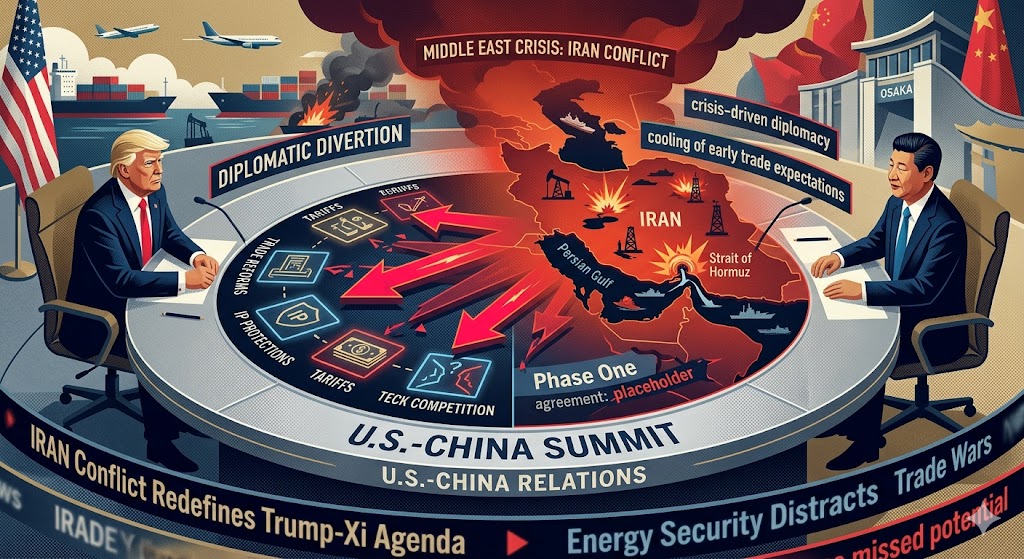
The high-stakes meeting between President Donald Trump and President Xi Jinping, initially conceived as a pivotal moment to recalibrate the fractured economic relationship between the United States and China, has been fundamentally altered by the escalating conflict in Iran. What was intended to be a deep dive into structural trade reforms, intellectual property protections, and technological competition has instead been eclipsed by the urgent necessity of addressing a potential regional war. This shift in focus represents a significant diplomatic pivot, as the immediate volatility in the Persian Gulf demands the attention of both leaders, leaving the long-term bilateral grievances that have defined the last decade of Sino-American relations relegated to the periphery.
The cause of this diplomatic distraction stems from the diverging interests and obligations both superpowers hold within the Middle East. For the United States, the strategic objective remains the containment of Iranian influence and the enforcement of a maximum pressure campaign designed to curb Tehran’s nuclear ambitions. Conversely, China views the region primarily through the lens of energy security and the preservation of its Belt and Road Initiative investments. This fundamental disagreement on how to manage the Iranian crisis has created a secondary friction point at the summit, effectively draining the political capital necessary to solve the primary economic disputes that have led to a protracted trade war.
The effect of this distraction is most visible in the cooling of early expectations for a comprehensive trade breakthrough. Prior to the escalation in Iran, negotiators on both sides had signaled a cautious optimism regarding a “Phase One” agreement that would stabilize markets. However, the shadow of a broader military conflict has introduced a new layer of uncertainty that makes long-term economic commitments difficult to solidify. Investors and policymakers alike are now forced to weigh the benefits of trade concessions against the systemic risk of an energy price shock or a disruption in global shipping lanes, both of which are direct consequences of the unrest in the Middle East.
Furthermore, the Iran conflict has forced President Xi into a defensive strategic posture. China, as the world’s largest importer of crude oil, is acutely sensitive to any instability that threatens the flow of energy through the Strait of Hormuz. Because Beijing maintains a comprehensive strategic partnership with Tehran, any U.S.-led escalation places China in a position where it must either challenge American hegemony in the region or risk losing its energy lifeline. This dilemma has complicated the summit’s agenda, as Xi must now navigate the trade talks with the knowledge that his domestic economic stability is tethered to a region currently on the brink of kinetic warfare.
From the American perspective, the timing of the Iran crisis has inadvertently weakened the administration’s leverage in trade negotiations. While the Trump administration seeks to use tariffs as a tool to force Chinese concessions, the need for international cooperation to manage Iran provides Beijing with a counter-leverage. China’s role as a permanent member of the UN Security Council and its continued economic ties with Iran allow it to act as a potential spoiler or a mediator. This dynamic has diluted the singular focus on trade, as the White House must now consider how its economic pressure on Beijing might influence China’s willingness to cooperate on Middle Eastern security issues.
The resulting diplomatic stagnation has led to a marginalization of critical issues such as artificial intelligence standards, cybersecurity, and maritime rights in the South China Sea. These topics, which represent the core of the long-term strategic rivalry between the two nations, require sustained, high-level engagement to resolve. By shifting the summit’s oxygen toward the immediate crisis in Iran, both leaders have missed a vital window of opportunity to establish a “floor” for their relationship. The cause-and-effect relationship here is clear: immediate tactical emergencies are currently preventing the execution of a long-term strategic roadmap.
Economic analysts suggest that the distraction by the Iran war could lead to a “placeholder” agreement rather than the substantive resolution the global market had hoped for. The volatility in oil prices, triggered by the threat of war, acts as a regressive tax on both the American and Chinese economies, further incentivizing a quick, albeit superficial, pause in trade hostilities. However, a pause born out of distraction is inherently fragile. Without addressing the underlying structural issues of the trade relationship, any temporary reprieve is likely to collapse once the immediate threat in the Middle East subsides or evolves into a new phase of the conflict.
The analytical depth of this summit also reveals a growing trend of “crisis-driven diplomacy,” where the global agenda is increasingly set by unforeseen external shocks rather than planned bilateral cooperation. The Iran situation serves as a catalyst that exposes the lack of a robust crisis-management framework between Washington and Beijing. Because the two powers do not have a shared vision for Middle Eastern stability, the conflict acts as a wedge that drives them further apart, even as they sit across the table from one another to discuss trade and commerce.
In the broader geopolitical context, the distraction provided by Iran allows other regional players to exploit the vacuum left by the preoccupied superpowers. As Trump and Xi focus on the immediate repercussions of the war, secondary issues like the stability of global supply chains and the development of 5G infrastructure are being decided by default rather than by design. This lack of clear leadership from the world’s two largest economies creates a ripple effect of uncertainty that extends far beyond the borders of Iran, affecting emerging markets and traditional allies who look to the summit for a sign of global stability.
As the summit concludes, the primary takeaway is likely to be one of missed potential. The intrusion of the Iran war has proved that the U.S.-China relationship does not exist in a vacuum. The cause of the current diplomatic dimming is the collision of local regional conflicts with global superpower competition. The effect is a summit that, while avoiding a total breakdown, fails to achieve the “grand bargain” that was once thought possible. The shadow of uncertainty has not merely dimmed the hopes of the summit; it has fundamentally redefined the parameters of what can be accomplished in an era of multi-theater instability.
Looking forward, the implications of this distracted summit are profound. If the United States and China cannot decouple their bilateral trade negotiations from the volatility of Middle Eastern geopolitics, the world may enter a period of permanent diplomatic reactive mode. The inability to compartmentalize the Iran crisis suggests that future summits will remain vulnerable to similar shocks, whether they originate in Eastern Europe, the Korean Peninsula, or the digital realm. This suggests a future where strategic planning is constantly sidelined by tactical firefighting, leaving the foundational issues of the 21st-century global order unresolved.
Ultimately, the Trump-Xi meeting serves as a sober reminder that the path to a stable bilateral relationship is fraught with external complexities. While both leaders may desire a resolution to the trade war to bolster their respective domestic economies, the reality of global leadership requires them to navigate a world that is increasingly interconnected and volatile. The distraction of the Iran war is not merely a temporary detour; it is a symptom of a new geopolitical reality where the domestic and foreign policy objectives of the superpowers are constantly being reshaped by forces beyond their immediate control.