
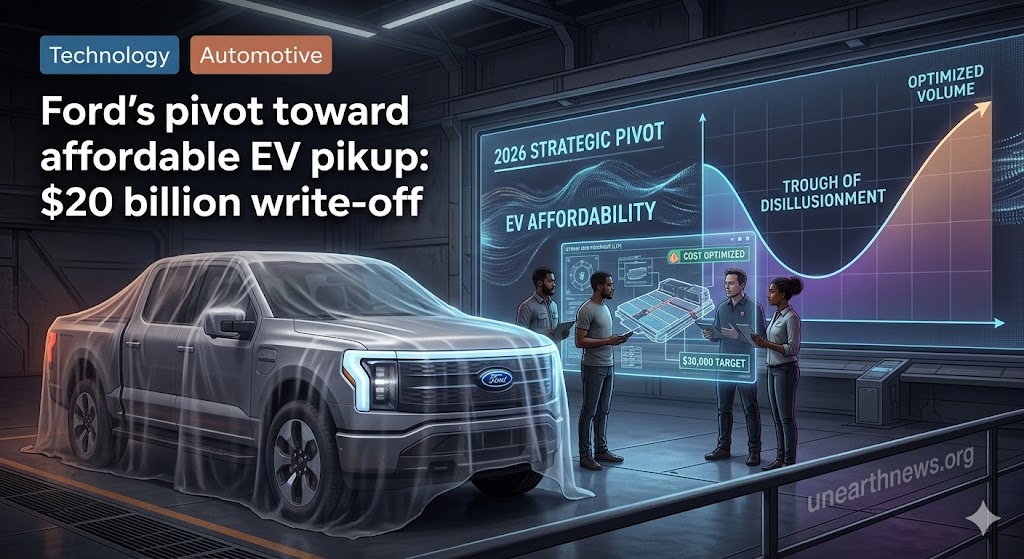
Ford Motor Company’s recent announcement regarding its pivot toward an affordable electric pickup truck marks a significant turning point in the domestic automotive industry’s transition to sustainable energy. After accounting for a staggering $20 billion write-off in previous electric vehicle investments, the Detroit automaker is signaling a shift away from high-priced, niche products toward mass-market accessibility. This strategic course correction suggests that Ford has recognized a fundamental misalignment between its initial capital allocation and the actual purchasing power of the average consumer. By targeting a $30,000 price point for its next-generation electric pickup, the company is attempting to bridge the gap between environmental goals and economic reality.
The financial write-off, while substantial, should not be viewed as an abandonment of electrification but rather as a necessary pruning of inefficient legacy projects. The cause of this massive fiscal restructuring lies in the slowing demand for premium electric vehicles, which were initially expected to fund the transition through high margins. However, as interest rates remained elevated and the early-adopter market reached saturation, Ford faced a reality where expensive models like the F-150 Lightning were no longer enough to sustain the momentum. The effect of this market cooling has forced Ford to reconsider its engineering philosophy, moving away from retrofitting internal combustion designs toward a clean-sheet, cost-optimized platform.
Central to this new strategy is a specialized “skunkworks” team based in California, led by former Tesla engineers who are tasked with reinventing the manufacturing process. This team is focused on stripping away the complexities that have historically driven up the cost of electric vehicle production. The goal is to create a platform that is not only cheaper to build but also more efficient in its use of raw materials, particularly concerning battery chemistry and weight distribution. This shift in personnel and location indicates that Ford is adopting a tech-centric culture to compete with more agile rivals who have successfully lowered production costs through vertical integration.
The $30,000 target price is particularly significant because it addresses the primary barrier to electric vehicle adoption: the affordability gap. For years, the industry has struggled with the fact that electric trucks often cost significantly more than their gasoline counterparts, making them a difficult sell for fleet owners and middle-income families. By aiming for a price point that aligns with traditional mid-size pickups, Ford is positioning itself to capture a demographic that has remained largely on the sidelines. If successful, this move could trigger a ripple effect throughout the industry, forcing competitors to accelerate their own low-cost programs or risk losing substantial market share.
From a technical standpoint, achieving such a low price point requires a radical departure from current battery standards. Industry analysts speculate that Ford will likely utilize Lithium Iron Phosphate (LFP) batteries, which are cheaper to produce and more durable than the Nickel Manganese Cobalt (NMC) variants commonly found in high-performance EVs. While LFP batteries typically offer lower energy density, they provide the thermal stability and longevity necessary for a work-oriented vehicle. This technical compromise is a calculated risk, prioritizing daily utility and cost-effectiveness over record-breaking range figures, which often go unused by the average driver.
The market implications of a $30,000 electric pickup extend beyond consumer sales and into the realm of infrastructure and public policy. As Ford pushes for mass-market volume, the demand for accessible charging stations will likely intensify, putting pressure on both government agencies and private providers to expand the current grid. Furthermore, the success of this vehicle will be a litmus test for the efficacy of federal tax credits and domestic manufacturing incentives. If Ford can manufacture this vehicle profitably within the United States, it will validate the current industrial policy aimed at decoupling the electric vehicle supply chain from international dependencies.
Competitive pressure is another driving force behind this sudden urgency. Manufacturers like BYD in China and Tesla in the United States have already demonstrated that scale and simplified design are the only paths to profitability in the EV space. Ford’s decision to write off $20 billion is a direct consequence of the realization that its previous multi-platform approach was too fragmented and costly to compete on a global stage. By consolidating its efforts into a single, high-volume, affordable platform, Ford is attempting to replicate the economies of scale that allowed the Model T to dominate the early 20th century.
Customer sentiment toward electric trucks has been mixed, largely due to concerns regarding towing capacity and cold-weather performance. Ford must ensure that its affordable pickup does not compromise on the “Built Ford Tough” brand identity that has sustained its market dominance for decades. The cause-and-effect relationship here is clear: if the vehicle feels like a “budget” compromise, it will fail to win over the loyalist base of the F-Series. However, if Ford can deliver a rugged, functional tool at a price that rivals internal combustion engines, it could effectively dismantle the remaining psychological barriers to EV ownership for truck enthusiasts.
Investors are watching this transition with a mixture of skepticism and cautious optimism. The immediate impact of the multi-billion dollar write-off has put pressure on Ford’s stock price and sparked debates regarding the leadership’s long-term vision. Nevertheless, the pivot toward affordability is widely regarded by market analysts as the only viable path forward. The automotive sector is currently in a “trough of disillusionment” regarding electric vehicles, where the initial hype has faded, leaving only the difficult work of optimizing costs and improving reliability. Ford’s admission of past mistakes and its focus on a 2025 release suggests a newfound pragmatism.
The operational restructuring within Ford’s “Model e” division is also a key factor in this evolution. By separating its electric business from its traditional internal combustion and commercial fleet divisions, Ford has been able to identify exactly where capital was being wasted. The $20 billion write-off serves as a clearing of the decks, allowing the electric division to operate with a leaner balance sheet and a more focused mission. This structural clarity is essential for a company of Ford’s size, which often struggles with the inertia of legacy management practices and high overhead costs.
Looking ahead to next year, the arrival of this affordable pickup will serve as a major benchmark for the success of the American energy transition. If Ford meets its $30,000 goal, it will prove that electric propulsion is not merely a luxury feature for the wealthy but a viable technology for the working class. This would likely lead to an acceleration of fleet conversions and a more rapid decline in the market share of traditional gasoline engines. The stakes are high; a failure to deliver on this promise could lead to further financial instability and a loss of investor confidence in Ford’s ability to navigate the digital age.
In summary, Ford’s strategic pivot represents a sophisticated gamble on the future of the automotive market. The company is trading short-term financial pain for a chance at long-term dominance in the most competitive segment of the industry. By focusing on affordability, simplified engineering, and a lean manufacturing culture, Ford is attempting to solve the very problems that led to its recent multi-billion dollar losses. The upcoming year will determine whether this new direction is a successful rebirth or a costly miscalculation, but one thing is certain: the era of the high-margin, low-volume electric vehicle is rapidly coming to an end.