
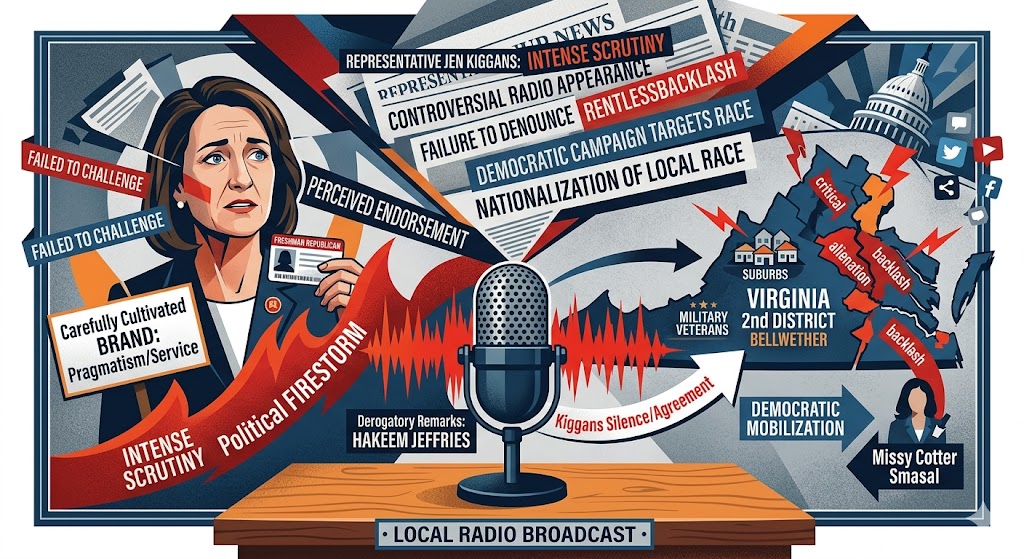
Republican Representative Jen Kiggans Faces Intense Scrutiny Following Controversial Radio Appearance and Remarks Regarding House Minority Leader Hakeem Jeffries
Representative Jen Kiggans, a freshman Republican representing Virginia’s pivotal Second Congressional District, has found herself at the center of a growing political firestorm. The controversy stems from a recent appearance on a local radio program during which the host directed a racially charged remark toward House Minority Leader Hakeem Jeffries. Kiggans’ failure to challenge the comment, and her subsequent vocal agreement with the segment’s overall sentiment, has ignited a wave of criticism from political opponents and civil rights advocates alike, threatening to shift the dynamics of one of the most competitive re-election battles in the country.
The incident occurred during a broadcast where the host used derogatory language to describe Jeffries, the first Black lawmaker to lead a major political party in either chamber of Congress. By failing to distance herself from the inflammatory rhetoric, Kiggans has provided her political rivals with significant ammunition. The cause-and-effect relationship in this scenario is immediate: the lack of a timely denunciation has translated into a perceived endorsement of the host’s views, leading to a rapid mobilization of Democratic groups and local community leaders who argue that such rhetoric has no place in contemporary political discourse.
Virginia’s Second Congressional District, which encompasses Virginia Beach and parts of the Eastern Shore, is widely regarded as a bellwether for national political trends. The district features a significant population of military veterans and suburban voters who often prioritize stability and professional decorum. For Kiggans, a former Navy helicopter pilot and geriatric nurse practitioner, her brand has largely been built on a platform of pragmatism and service. This recent controversy threatens to undermine that carefully cultivated image, potentially alienating moderate and independent voters who are sensitive to issues of racial equity and civil civility.
The Democratic Congressional Campaign Committee and local challengers have moved quickly to capitalize on the situation. By framing Kiggans’ silence as a reflection of her underlying political character, opponents are attempting to nationalize the local race. This strategy aims to link Kiggans to the more polarizing elements of the national Republican party, thereby making the election a referendum on social values rather than a debate on local economic or military issues. The effectiveness of this strategy will likely depend on how Kiggans manages the fallout in the coming weeks and whether she issues a formal clarification or apology.
From an analytical perspective, the incident highlights the inherent risks that politicians face when engaging with niche media outlets that cater to specific ideological bases. While local radio appearances are essential for maintaining grassroots support, they often lack the guardrails found in more mainstream journalistic environments. Kiggans’ predicament serves as a case study in the dangers of “passive validation,” where a candidate’s desire to remain in sync with a sympathetic host leads them to overlook or tacitly approve of rhetoric that would be considered disqualifying in a broader public forum.
Hakeem Jeffries’ role in this controversy is also significant. As a high-profile leader and a symbol of historic progress within the Democratic Party, attacks against him often resonate beyond the immediate political context. For many voters, particularly those in the district’s Black communities, the use of racially tinged language is not merely a political disagreement but a fundamental affront to personal and collective identity. Consequently, the backlash against Kiggans is not just about a single radio segment; it is about the broader climate of inclusivity and respect within the Republican Party’s leadership ranks.
The Republican Party’s “big tent” strategy is currently under strain as it attempts to balance the demands of a populist base with the sensibilities of suburban moderates. In swing districts like Virginia’s Second, the margin for error is razor-thin. Kiggans’ re-election bid was already expected to be a high-stakes contest, and this controversy adds a layer of volatility that could influence fundraising and volunteer enthusiasm. National GOP strategists may now be forced to divert additional resources to the district to counteract negative messaging, potentially draining funds from other vulnerable incumbents.
There is also a significant demographic component to this controversy. The district has a diverse population, and the growth of minority voting blocs in Virginia has made racial sensitivity a critical component of any successful campaign strategy. By failing to navigate the radio host’s comments effectively, Kiggans may have inadvertently lowered the floor of her support among minority constituents. If these voters perceive her as indifferent to racial insults, their turnout could become a decisive factor in a close election, favoring her Democratic challenger, Missy Cotter Smasal.
The media cycle surrounding this event demonstrates the speed at which local gaffes can transition into national headlines. In the age of digital recording and social media, no campaign appearance is truly private or localized. The clip of the radio exchange has been widely circulated online, ensuring that the controversy remains in the public consciousness longer than a traditional print story might. This persistent digital presence makes it difficult for Kiggans to “pivot” back to her core campaign messages of economic growth and national security.
In response to the uproar, Kiggans’ campaign has attempted to refocus the narrative on her legislative record and the shortcomings of the current administration. However, the success of such a pivot is often hindered when the initial controversy touches upon deeply held values of decency and equality. Political analysts suggest that the “stickiness” of this issue is due to the clear contrast it provides between the candidates’ perceived temperaments. In a race where policy differences are often nuanced, personality and character traits become the primary differentiators for undecided voters.
Looking ahead, the long-term impact on Kiggans’ career will depend on her ability to perform damage control without alienating her core conservative supporters. This is a difficult political tightrope to walk. If she apologizes too forcefully, she risks a backlash from the right-wing media figures who frequent such radio shows. If she remains defiant or dismissive, she risks losing the center-right voters who are essential for a Republican victory in a coastal Virginia district. The resulting strategic paralysis could be just as damaging as the initial remark itself.
Ultimately, this episode underscores the heightened sensitivity of the current American political landscape. In an era of intense polarization, the words—and silences—of elected officials are scrutinized with unprecedented rigor. Representative Kiggans’ experience serves as a stark reminder that in the quest for political survival, the failure to address divisive rhetoric can be just as consequential as the rhetoric itself. As the general election approaches, the fallout from this single radio appearance may very well determine the future of Virginia’s representation in Congress and the broader balance of power in Washington.