
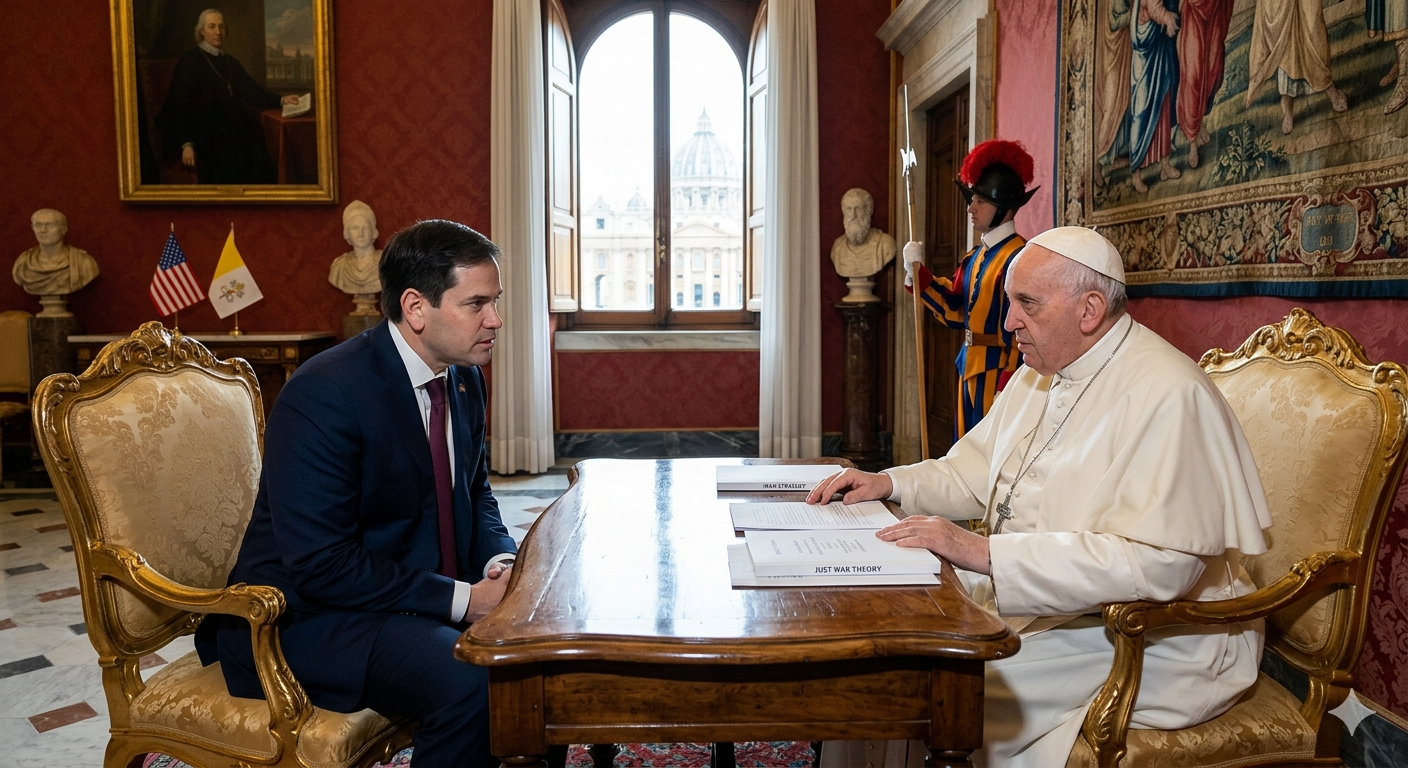
The recent visit of Senator Marco Rubio to the Vatican marks a pivotal moment in the diplomatic discourse between the Trump administration and the Holy See, occurring at a time of unprecedented theological and political friction. By engaging directly with Pope Leo XIV, Rubio is positioned as a mediator attempting to bridge the widening gap caused by the administration’s military strategy in Iran. This encounter is not merely a courtesy call but a strategic effort to navigate the complexities of international relations where religious moral authority often clashes with secular geopolitical interests. The significance of this meeting is underscored by the recent public disparagement of the Pontiff’s pacifist stance, which has created a unique set of challenges for American Catholic politicians and foreign policy advisors alike.
The root of the current tension lies in the escalating military posture the United States has adopted toward Iran, a development that Pope Leo XIV has vocally opposed on humanitarian and theological grounds. The Vatican’s stance is rooted in a centuries-old tradition of seeking peaceful resolutions to international conflicts, emphasizing the protection of civilian populations and the prevention of regional destabilization. When the Pope issued a formal plea for a ceasefire and diplomatic engagement, it was met not with the customary diplomatic acknowledgment, but with a sharp rebuke from the President. This public disagreement has highlighted a fundamental clash between the “America First” doctrine and the Holy See’s commitment to global multilateralism and non-violence.
President Trump’s condemnation of the Pope represents a significant departure from established diplomatic norms, where the Office of the President generally avoids direct public confrontation with religious leaders. The administration has argued that the Pope’s opposition to the conflict fails to account for the immediate threats posed by the Iranian regime to global security and American interests. This rhetorical offensive has created a cause-and-effect loop where political assertions of strength are perceived by the Vatican as a disregard for human life, while the Church’s calls for peace are characterized by the White House as naive or counterproductive. Such a high-profile rift risks alienating a significant portion of the international community that views the Vatican as a crucial voice in global ethics.
Senator Rubio’s role as an intermediary is particularly relevant given his history of aligning himself with both conservative political goals and traditional Catholic values. For Rubio, the meeting provides an opportunity to clarify the administration’s intentions while also listening to the Holy See’s concerns regarding the potential for a total regional collapse in the Middle East. The effect of this outreach could lead to a softening of rhetoric on both sides, or at the very least, a shift toward more private channels of communication. Rubio’s challenge lies in demonstrating that the United States can pursue its national security objectives without fundamentally breaking its historical and moral ties with the Catholic Church.
The theological implications of this conflict cannot be overstated, as they touch upon the “Just War” theory that has long governed the ethical considerations of military action within the Church. Pope Leo XIV has argued that the current escalation does not meet the stringent criteria required for a just war, specifically pointing to the potential for disproportionate harm to civilians and the lack of exhaustive diplomatic efforts. The administration’s rejection of this view suggests a widening divide between secular military doctrine and religious ethical frameworks. As this debate unfolds, it forces a re-examination of how religious institutions influence modern statecraft and whether their influence is waning in an era of nationalist foreign policy.
Domestically, the tension between the Trump administration and the Vatican has the potential to impact the American political landscape, particularly among Catholic voters. This demographic is a critical constituency in several swing states, and a prolonged public dispute between the President and the Pope could lead to a fragmentation of support. Rubio’s meeting is partly a move to reassure these voters that the administration remains respectful of the Church’s leadership, even when policy disagreements arise. The political risk is that the President’s criticism could be seen as an attack on the faith itself, rather than a specific disagreement over foreign policy, which could have long-lasting effects on partisan alignments.
The Holy See’s influence extends far beyond the borders of Italy, acting as a soft-power superpower that can sway public opinion across Europe, Latin America, and Africa. By opposing the war in Iran, Pope Leo XIV is effectively mobilizing a global moral consensus that contrasts with the American position. This isolation of the United States on the moral stage can have tangible diplomatic effects, making it more difficult to secure international coalitions or humanitarian aid for regional stability. Rubio’s task in Rome is to mitigate this isolation by emphasizing common goals, such as the protection of religious minorities in the Middle East and the prevention of a nuclear-armed Iran.
From a geopolitical perspective, the friction between Washington and the Vatican creates a vacuum that other global powers may attempt to fill. As the United States and the Holy See remain at odds, nations like France and Germany, which have also expressed reservations about the conflict, may find their positions bolstered by the Vatican’s moral support. This alignment could lead to a shift in transatlantic relations, where European leaders feel more emboldened to challenge American unilateralism. The effect of Rubio’s visit will therefore be monitored closely by international observers to see if the United States can successfully realign itself with its traditional moral and strategic partners.
The Vatican’s commitment to humanitarianism is another central pillar of the current dispute. Church leaders are deeply concerned that a full-scale war with Iran would trigger a massive refugee crisis and further destabilize neighboring countries that are already struggling with the aftermath of previous conflicts. During his meeting, Rubio likely faced difficult questions regarding the administration’s plans for post-conflict stabilization and humanitarian relief. The failure to provide satisfactory answers to these concerns would only deepen the Vatican’s opposition and solidify the perception that American policy is driven by short-term military objectives rather than long-term regional health.
Institutional memory within the State Department and the Vatican’s Secretariat of State also plays a role in how this event is being handled. Historically, the two entities have worked together on a range of issues, from the fall of the Iron Curtain to the normalization of relations with Cuba. The current animosity threatens to dismantle decades of institutional cooperation. Rubio, through his seniority and committee roles, is one of the few figures capable of reminding both sides of the value of this partnership. His presence at the Vatican is an acknowledgment that despite current grievances, the institutional relationship is too significant to be discarded over a single policy disagreement.
As the situation develops, the effectiveness of Rubio’s diplomacy will be measured by the tone of future communications from both the White House and the Holy See. If the President tempers his public remarks and the Pope shifts toward a more collaborative tone, it will be viewed as a success for Rubio’s mediation. However, if the rhetoric remains sharp, it would indicate that the divide is not merely personal or stylistic, but represents a fundamental shift in how the United States intends to interact with moral authorities on the global stage. This could signal a move toward a more secularized and isolated American foreign policy that prioritizes raw power over traditional alliances.
In conclusion, the meeting between Senator Rubio and Pope Leo XIV is a high-stakes attempt to navigate one of the most complex diplomatic challenges of the current administration. The cause of the tension—a fundamental disagreement over military action in Iran—has led to a ripple effect that touches on theology, domestic politics, and global alliances. Rubio’s role as a bridge-builder is essential for preventing a permanent schism between the American government and the Catholic Church. The future of US-Vatican relations hinges on whether this dialogue can transform a period of public condemnation into a renewed understanding of the separate but overlapping roles that faith and statecraft play in the quest for global security.