
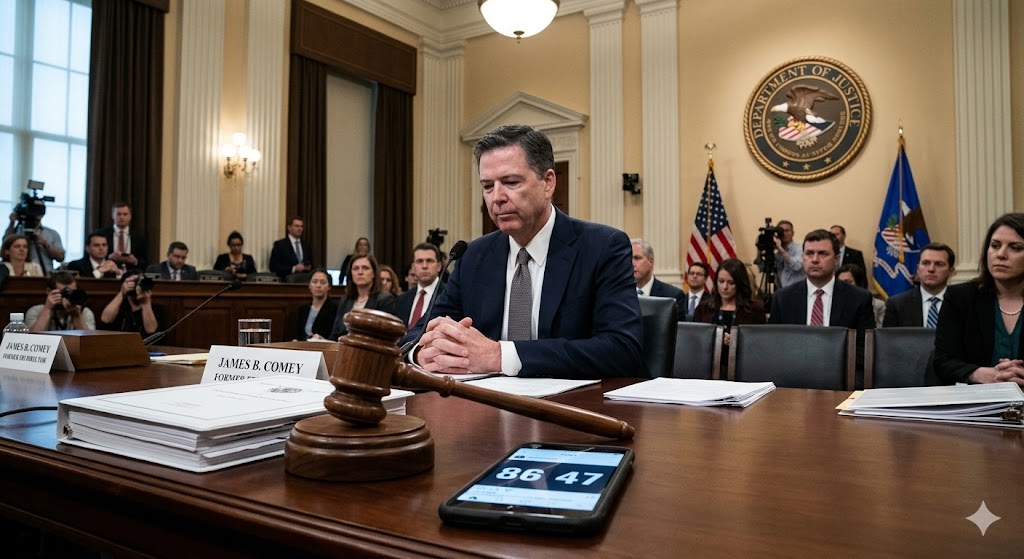
The recent announcement by Acting Attorney General Todd Blanche regarding the prosecution of former FBI Director James Comey has ignited a complex debate over the boundaries of political speech and the application of federal law. At the center of this legal firestorm is a social media post featuring the numerical code 86 47, a shorthand widely understood in political circles to suggest the removal or rejection of the 47th President of the United States. While the phrase has proliferated across various digital platforms, the Justice Department’s decision to single out Comey for criminal charges while offering a de facto immunity to the general public suggests a significant shift in how the government evaluates the intersection of influence, intent, and executive safety.
Todd Blanche clarified that the mere act of posting the message was not the sole catalyst for the indictment, acknowledging that such rhetoric is posted constantly by private citizens. However, the cause-and-effect relationship in this specific case hinges on the status of the individual involved. By virtue of his former high-ranking position within the national security apparatus, Comey’s public statements carry a weight and an inherent institutional authority that the average user lacks. The Justice Department appears to be arguing that for a former director of the FBI, such a message transcends simple political dissent and enters the realm of a coordinated signal or a breach of the heightened standards of conduct expected of those who once held the nation’s highest clearances.
The legal strategy employed by the Acting Attorney General points toward the existence of undisclosed evidence that separates Comey’s actions from the background noise of internet commentary. While Blanche declined to specify the nature of this evidence, the implication is that the 86 47 post served as a visible manifestation of a deeper, more substantive pattern of behavior. This suggests that federal investigators may have gathered communications, logistical data, or testimonies that provide context to the post, transforming it from protected speech under the First Amendment into a component of a larger criminal enterprise or a specific threat against the executive branch.
From a constitutional perspective, this case raises profound questions regarding the Equal Protection Clause and the concept of selective prosecution. Critics argue that targeting a prominent political adversary for language used by thousands of others sets a dangerous precedent that could lead to the weaponization of the judiciary. However, the Justice Department’s stance is built on the premise that the harm caused by a statement is directly proportional to the reach and perceived intent of the speaker. In this view, the effect of Comey’s rhetoric is not just the potential incitement of his followers, but the erosion of the professional neutrality that is supposed to govern the conduct of former law enforcement leaders.
The decision to proceed with charges against Comey while publicly stating that others will not be prosecuted serves as a strategic maneuver to contain public backlash. By reassuring the general populace that they will not face legal repercussions for similar digital expressions, the Justice Department is attempting to isolate Comey as a unique threat. This approach is designed to mitigate concerns about a broad crackdown on free speech while simultaneously enforcing a strict code of accountability for high-profile figures who might leverage their former positions to influence political stability or jeopardize the security of the incumbent administration.
The “other evidence” mentioned by Blanche remains the most critical variable in the future of this legal proceeding. If the Justice Department fails to produce substantial proof that links the social media post to a tangible plan or a direct violation of federal statutes, the prosecution risks being perceived as a purely political exercise. Conversely, if the evidence reveals that Comey was utilizing his platform to facilitate actions that go beyond the scope of traditional political advocacy, the case could redefine the legal obligations of former government officials in the digital age, establishing a new boundary for what constitutes an actionable threat.
Furthermore, the timing of these charges suggests a proactive effort by the current administration to establish a deterrent against internal dissent from the bureaucratic and intelligence communities. By targeting a figure as prominent as a former FBI director, the Justice Department is sending a clear signal to other current and former officials that their public conduct remains under intense scrutiny. The intended effect is a chilling of coordinated political opposition from within the ranks of former executive branch leadership, thereby consolidating the authority of the 47th presidency against perceived institutional resistance.
The broader implications for digital jurisprudence are equally significant. This case highlights the increasing reliance on social media activity as a trigger for federal investigations. In the modern era, a single post can serve as the legal “probable cause” necessary to execute search warrants and uncover deeper troves of data. In Comey’s situation, the post was likely the tip of the iceberg, providing the necessary justification for the Justice Department to probe deeper into his private communications and professional associations, eventually leading to the discovery of the undisclosed evidence cited by Blanche.
As the legal process moves into the discovery phase, the public will likely demand more transparency regarding the specific nature of the charges. The tension between national security interests and the right to public information will be a recurring theme. If the Justice Department continues to withhold the details of the “other evidence,” they may maintain the element of surprise in court, but they risk losing the battle for public opinion. The analytical challenge lies in determining whether the government is protecting the presidency from a legitimate threat or if it is redefining the law to silence a specific and effective critic.
Ultimately, the prosecution of James Comey for the 86 47 message represents a landmark moment in the history of American law and politics. It underscores a shift toward a more aggressive interpretation of the laws governing threats and the conduct of public officials. While the acting attorney general’s assurances may provide some comfort to the average social media user, the reality is that the legal landscape has shifted. The case establishes that in the eyes of the current Justice Department, the identity of the speaker is just as important as the content of the speech, and the consequences of one’s words are now inextricably linked to the power they once wielded.
In the coming months, the judicial system will be tasked with weighing these competing interests. The outcome of the Comey trial will likely dictate the rules of engagement for political discourse for years to come. If the government succeeds, it will have created a powerful precedent for the surveillance and prosecution of former officials based on a combination of public rhetoric and private intent. If the defense prevails, it may reinforce the protections of the First Amendment, ensuring that even the most controversial political statements remain within the bounds of legal expression, regardless of the speaker’s former title or influence.
In summary, the distinction drawn by Todd Blanche between the general public and James Comey is not merely a matter of legal technicality but a fundamental assertion of executive authority. The cause—a perceived threat amplified by institutional stature—has led to the effect of a targeted criminal prosecution. Whether this move stabilizes the political environment or further polarizes the nation will depend on the strength of the evidence yet to be revealed and the ability of the courts to maintain impartiality in an increasingly fractured legal landscape.