
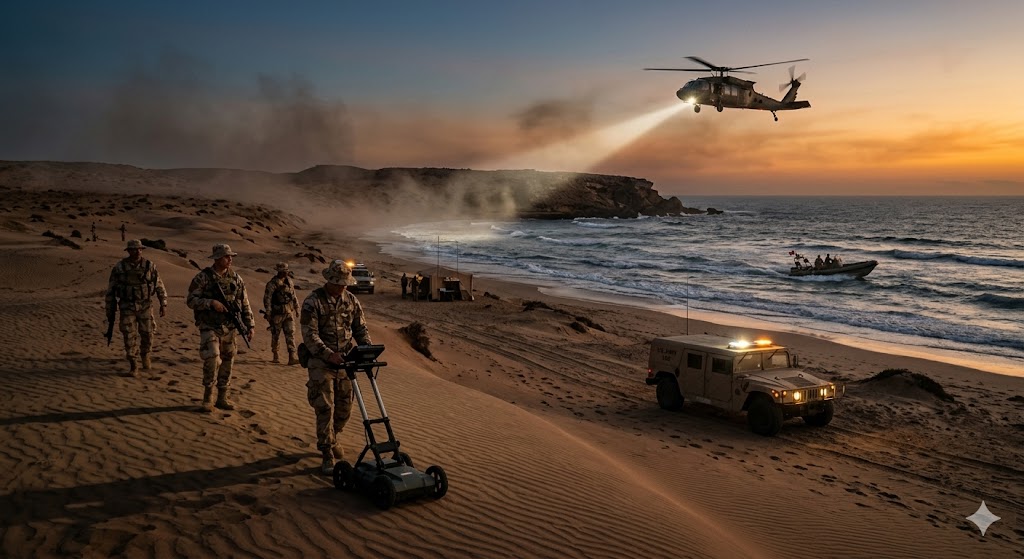
The disappearance of two United States Army service members during a high-stakes military exercise in Morocco has triggered an intensive search and rescue operation, highlighting the inherent risks associated with large-scale multinational training maneuvers. The incident occurred on Saturday near the Cap Draa Training Area, a strategically significant coastal zone in southwestern Morocco known for its unforgiving terrain and complex maritime environment. As the search efforts continue, the event has drawn international attention to the logistical and safety challenges of conducting joint operations in remote and geographically diverse regions.
The exercise in question is part of a broader framework of military cooperation between the United States and Morocco, often exemplified by the annual African Lion exercise. This massive undertaking involves thousands of personnel from various nations and is designed to enhance interoperability, bolster regional security, and refine the tactical capabilities of participating forces. The disappearance of personnel during such a coordinated event suggests a significant disruption in standard operational procedures or the intervention of environmental factors that complicated the expected flow of the training mission.
Geographically, the Cap Draa region presents a unique set of challenges that can exacerbate the difficulty of military training. Situated where the Sahara Desert meets the Atlantic Ocean, the area is characterized by heavy winds, shifting sands, and unpredictable maritime conditions. These environmental variables create a “fog of war” scenario even in controlled exercises, where visibility can drop rapidly and communication equipment can be hampered by atmospheric conditions. Such factors likely played a role in the initial separation of the service members from their unit.
In response to the disappearance, the U.S. Africa Command (AFRICOM) has mobilized a comprehensive search and rescue effort in close coordination with the Royal Moroccan Armed Forces. This bilateral response underscores the strength of the security partnership between Washington and Rabat. The mobilization includes aerial surveillance, ground search teams, and potentially naval assets, leveraging advanced sensory technology to scan the vast and rugged landscape. The speed and scale of the response are indicative of the priority the military places on personnel recovery and the gravity of the situation.
From a tactical perspective, the incident necessitates a rigorous analysis of the specific training module being conducted at the time of the disappearance. Whether the soldiers were involved in a maritime landing, a reconnaissance mission, or a navigational exercise, the failure to maintain contact indicates a potential breakdown in the “buddy system” or tracking technology. Military investigators will likely focus on whether the equipment used for real-time positioning was functioning correctly or if the intensity of the exercise led to unforeseen tactical errors.
The strategic implications of this event extend beyond the immediate search efforts. Morocco is a Major Non-NATO Ally and serves as a cornerstone of U.S. security policy in North Africa and the Sahel. Any incident that results in the loss or potential harm of service members during joint exercises triggers a review of the safety protocols governing these partnerships. While the primary goal remains the safe return of the missing soldiers, the secondary effect is often a temporary pause or recalibration of training intensity to ensure that risks are being managed effectively without compromising the realism of the drill.
Public and political scrutiny often follows such high-profile incidents, especially when they occur on foreign soil. The U.S. Department of Defense faces the challenge of balancing transparency with the operational security required to conduct a search and rescue mission. For the families of the service members, the uncertainty of a “missing” status creates a profound emotional burden, which in turn places pressure on military leadership to provide timely updates and a clear accounting of the events leading up to the disappearance.
Furthermore, the incident highlights the vital role of communication infrastructure in joint military environments. Interoperability is not just about shared tactics but also about compatible communication systems. If there were discrepancies in how U.S. and Moroccan units were sharing data or monitoring personnel locations, this could have contributed to the delay in identifying the disappearance. Future exercises will likely see an increased emphasis on redundant tracking systems and cross-platform communication to prevent a recurrence.
Historically, joint military exercises have been prone to accidents due to their inherent complexity. The history of large-scale maneuvers shows that while safety is a paramount concern, the push for realistic combat scenarios often brings troops close to the edge of safety margins. This incident will serve as a case study for future exercise planners to evaluate the balance between creating a challenging environment for soldiers and ensuring that fail-safes are robust enough to account for human error or environmental extremes.
The search for the missing soldiers also tests regional stability and the perception of U.S. military presence in the area. Adversarial actors or regional competitors may view such incidents as signs of operational vulnerability. Consequently, the efficiency with which the U.S. and Morocco resolve this crisis will be interpreted as a measure of their collective readiness and the resilience of their military alliance. A successful and rapid recovery would reinforce the image of a professional and highly capable partnership.
Looking ahead, the findings of the subsequent military inquiry will be critical for the evolution of the U.S. Army’s training doctrine in North Africa. If the disappearance is linked to specific topographical or climatic challenges unique to Cap Draa, future training schedules may be adjusted to account for seasonal hazards. Additionally, the integration of more sophisticated individual tracking devices may become a standard requirement for all personnel participating in exercises that involve high-risk environments or coastal operations.
In conclusion, the disappearance of the two service members in Morocco is a sobering reminder of the costs and complexities of maintaining global military readiness. The ongoing search efforts reflect the deep commitment of the U.S. military to its personnel and the solid cooperation it maintains with international allies like Morocco. As the military community awaits word on the fate of the soldiers, the event serves as a catalyst for deeper analysis into the safety, strategy, and execution of multinational military operations in an increasingly unpredictable world.