
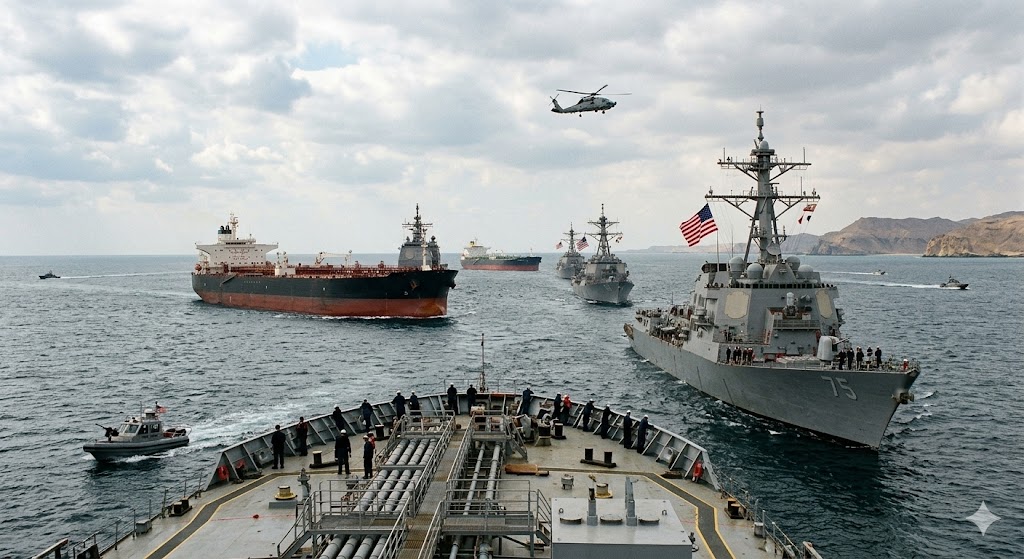
Project Freedom and the Strategic Recalibration of Maritime Security in the Strait of Hormuz
The recent announcement by the Trump administration regarding the initiation of Project Freedom signifies a major shift in American maritime doctrine within the Persian Gulf. By pledging to assist stranded or obstructed vessels in the Strait of Hormuz, the United States is moving beyond its traditional role of monitoring regional stability and toward a more assertive, interventionist stance. This policy change is rooted in the necessity of maintaining the flow of global commerce through one of the world’s most critical maritime chokepoints, where any disruption can have immediate and severe consequences for international energy markets and supply chain integrity.
Central to this new initiative is the rhetoric of forceful deterrence, which serves as both a psychological and strategic warning to regional actors, particularly Iran. The Strait of Hormuz facilitates the passage of approximately one-fifth of the world’s total oil consumption, making it a focal point of global economic security. By stating that interference will be met with force, the administration seeks to restore a sense of predictability for commercial shipping companies that have grown increasingly wary of the rising risks of seizure or sabotage in these volatile waters.
The lack of specific technical details regarding Project Freedom suggests a strategy of strategic ambiguity, designed to keep potential adversaries off-balance while maintaining operational flexibility. It remains unclear whether the program will involve direct naval escorts, enhanced aerial surveillance, or the establishment of protected transit corridors. However, the intent behind the program is clear: the U.S. aims to project a posture of dominance that discourages non-state actors and rival nations from using maritime harassment as a tool of geopolitical leverage.
One of the primary drivers behind this move is the immediate economic pressure exerted by rising maritime insurance premiums. In recent months, the cost of insuring tankers passing through the Gulf of Oman and the Strait of Hormuz has surged, adding significant overhead to the global supply chain. By providing a security guarantee through Project Freedom, the U.S. government hopes to stabilize these costs, thereby preventing a trickle-down effect that could lead to higher fuel prices for consumers worldwide and inflation in energy-dependent industries.
From a historical perspective, Project Freedom draws parallels to Operation Earnest Will in the late 1980s, during which the U.S. Navy escorted Kuwaiti tankers to protect them from attacks during the Iran-Iraq War. However, the modern context is more complex due to the advancement of asymmetric warfare capabilities, such as drone swarms and sophisticated sea mines. The re-emergence of such a program indicates that the U.S. perceives the current threat level as comparable to the most dangerous periods of the Tanker War, necessitating a high-profile military commitment to preserve the freedom of navigation.
The geopolitical implications of this project are profound, particularly concerning the fragile relationship between Washington and Tehran. Iran has long viewed the presence of Western naval forces in the Persian Gulf as a direct provocation and an infringement on its territorial influence. The introduction of Project Freedom could inadvertently lead to a security dilemma, where defensive measures taken by the U.S. are interpreted as offensive by Iran, potentially triggering a cycle of escalation that neither side may be able to easily contain without significant diplomatic intervention.
Furthermore, the program raises questions about the role of international law and the United Nations Convention on the Law of the Sea. While the U.S. has not ratified the convention, it generally adheres to its principles regarding transit passage through international straits. Project Freedom reinforces the U.S. position as the primary guarantor of these rights, but it also places the burden of enforcement almost entirely on American resources, testing the limits of the nation’s policy when it conflicts with global police responsibilities and the desire to reduce foreign military expenditures.
Allied response will be a critical factor in the success and sustainability of the program. For Project Freedom to be viewed as a legitimate international effort rather than a unilateral military move, the administration will likely need to secure cooperation from regional partners like Saudi Arabia and the United Arab Emirates, as well as European allies. A coalition-based approach would share the logistical and financial burden while also providing a broader legal and diplomatic mandate for any forceful actions taken against interdiction or unlawful vessel seizures.
Domestically, the announcement serves as a signal of strength, aimed at demonstrating that the administration is capable of protecting American economic interests abroad without becoming entangled in a full-scale ground war. By focusing on naval and technological superiority, Project Freedom fits into a broader strategy of maximum pressure while attempting to avoid the political pitfalls of military overextension. The success of the project will likely be measured by its ability to prevent incidents through presence alone, without actually having to engage in kinetic conflict.
The potential for miscalculation remains the highest risk associated with this policy shift. In the narrow and crowded waters of the Strait of Hormuz, the margin for error is razor-thin. A tactical error by a single vessel commander or a misinterpreted maneuver could quickly spiral into a direct engagement. The administration’s promise to act forcefully creates a commitment that must be upheld to maintain credibility, but fulfilling that promise could lead to the very disruption of trade that the program is specifically designed to prevent.
Looking ahead, the global energy market will remain the ultimate barometer of Project Freedom’s effectiveness. If oil prices remain stable and the frequency of vessel seizures drops, the initiative will be hailed as a successful exercise in maritime deterrence. However, if tensions continue to simmer and shipping companies remain hesitant to traverse the strait without expensive private safeguards, the U.S. may find itself forced to commit even more naval assets to the region, leading to a long-term shift in global naval resource allocation and strategic focus.
Ultimately, Project Freedom represents a high-stakes gamble on the power of deterrence in an era of multi-polar regional friction. By asserting a forceful presence in the Strait of Hormuz, the U.S. is attempting to redefine the rules of engagement in maritime security and reassure global markets. The long-term impact of this decision will likely influence not only the stability of the Persian Gulf but also the broader future of international trade routes and the extent of American military influence in the 21st century.