
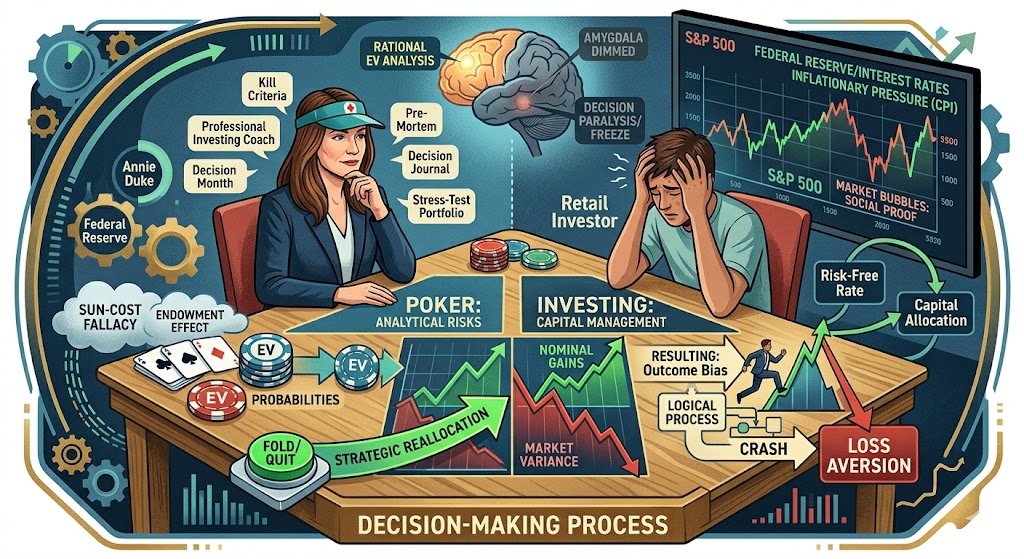
The intersection of behavioral economics and professional gambling offers a unique vantage point for understanding modern financial markets, a synthesis pioneered by former poker champion turned investing coach Annie Duke. Her analytical framework suggests that the primary obstacle to successful long-term capital appreciation is not a lack of technical data, but rather a profound misunderstanding of risk and the psychological friction inherent in decision-making. In a contemporary economic environment defined by fluctuating interest rates and rapid shifts in the S&P 500, Duke argues that most investors suffer from a cognitive bias known as “resulting.” This phenomenon occurs when individuals judge the quality of a decision based solely on its outcome rather than the logic of the process. In the high-stakes world of poker, a player can make a mathematically correct bet and still lose the hand; similarly, an investor can follow a rigorous thesis and still face a loss due to market variance.
The fallacy of resulting often leads to systemic overconfidence during bull markets. When the S&P 500 experiences prolonged periods of growth, investors tend to attribute their portfolio gains to superior stock-picking skills rather than a broad tide of liquidity. This misattribution masks underlying flaws in investment strategies, as the general upward trajectory of the market compensates for poor risk management. Duke’s analysis highlights that when the market eventually corrects, these investors are often caught unprepared, having failed to stress-test their portfolios against the possibility that their previous successes were merely the product of luck or favorable macro conditions rather than sustainable alpha generation.
Inflationary pressures have further complicated the risk-reward calculus for both retail and institutional participants. As the Consumer Price Index (CPI) fluctuates, the “risk-free” rate of return—typically tied to Treasury yields—undergoes significant adjustments, forcing investors to re-evaluate their asset allocations. Duke posits that many investors fail to account for the real, inflation-adjusted erosion of their capital, instead focusing on nominal gains. This lack of perspective often leads to “loss aversion,” where the psychological pain of a nominal loss outweighs the rational necessity of exiting a depreciating position. Consequently, capital remains trapped in underperforming assets when it should be redeployed to counteract the effects of a high-inflation environment.
Market bubbles serve as the ultimate case study for the inability to “quit,” a central theme in Duke’s recent work. Bubbles are sustained by a collective failure to recognize when an asset’s price has fundamentally decoupled from its intrinsic value. Driven by social proof and the fear of missing out (FOMO), investors often ignore quantitative warning signs in favor of the narrative-driven momentum of the crowd. Duke notes that the social cost of being the first to exit a lucrative trend is often perceived as higher than the financial cost of staying until the crash. This herd mentality creates a feedback loop where the cost of capital is ignored, and speculative fervor drives valuations to unsustainable levels until a liquidity event forces a correction.
The role of the Federal Reserve and its manipulation of interest rates acts as a primary catalyst for shifts in risk perception. During eras of quantitative easing and near-zero interest rates, the abundance of cheap capital encourages high-duration bets and speculative ventures. However, as the Federal Reserve transitions to a more hawkish stance to combat inflation, the opportunity cost of holding non-yielding or risky assets rises dramatically. Duke suggests that many investors fail to “quit” their low-interest-rate strategies quickly enough, remaining wedded to a regime that no longer exists. This lag in adaptation is a significant driver of portfolio drawdowns during periods of monetary tightening.
The endowment effect and the sunk cost fallacy represent two of the most pervasive psychological barriers to sound investing. Once an investor takes a position in a stock or a fund, they tend to value it more highly than they would if they did not own it. Duke highlights that the mental and financial energy already committed to an investment makes it difficult for an individual to admit that their original thesis was incorrect. This emotional attachment frequently leads to the “sunk cost” error, where investors “throw good money after bad” in a desperate attempt to break even. This behavior is counterproductive, as the market is indifferent to an investor’s entry price or their emotional commitment to a specific ticker.
Strategic quitting is often stigmatized in broader culture as a sign of failure or lack of resilience, yet Duke argues that it is a fundamental requirement for risk management. In professional poker, the ability to fold a hand is as critical as the ability to bet; in the markets, the ability to liquidate a position is essential for capital preservation. For the average investor, the reluctance to take a loss is a primary reason why portfolios underperform over time. By reframing “quitting” as a proactive decision to reallocate resources to higher-expected-value opportunities, investors can move away from a reactive stance and toward a more disciplined, probabilistic approach to wealth management.
During periods of extreme market volatility, investors frequently succumb to decision paralysis, or the “freeze” response. When the S&P 500 experiences sharp intraday drops or when global geopolitical tensions spike, the human brain’s amygdala often overrides the rational prefrontal cortex. This biological reaction prevents investors from executing necessary trades, such as hitting stop-loss orders or rebalancing into safer assets. Duke’s research suggests that the only way to combat this is through “pre-commitment” strategies. By establishing clear “kill criteria” before a trade is even placed, investors can remove the emotional burden of making a decision in the heat of a market panic.
The disparity between institutional and retail decision-making is often rooted in the rigor of their respective processes. Professional hedge fund managers and high-frequency traders are trained to view every position through the lens of expected value (EV). If the probability of a positive outcome shifts, the position is sized down or closed immediately. Retail investors, however, are more likely to view their investments through the lens of regret. Duke’s work with institutional clients focuses on closing this gap by implementing decision journals and “pre-mortems,” which require analysts to imagine a future failure and identify its causes before they occur, thereby neutralizing bias.
Applying a quantitative, data-driven approach to risk requires a shift in how investors perceive “certainty.” The market is a complex, adaptive system where perfect information is never available. Duke emphasizes that the best investors are those who are comfortable with ambiguity and who treat every investment as a bet on a specific probability. This mindset shift is crucial when dealing with macroeconomic variables like interest rate trajectories or corporate earnings forecasts. By acknowledging that every decision is a gamble based on incomplete data, investors can better insulate themselves against the shock of unexpected market movements and maintain a more objective perspective on their performance.
The impact of behavioral biases is not limited to individual portfolios but has broader implications for systemic economic stability. When a large segment of the market participants suffers from the same cognitive distortions—such as over-leveraging during periods of low volatility—it creates structural vulnerabilities. Duke’s analysis of risk suggests that market crashes are often the result of a sudden, collective realization that previous “resulting” was based on flawed logic. As liquidity dries up and interest rates rise, the “forced quit” that occurs during a margin call or a panic sell-off is much more damaging than a disciplined, voluntary exit would have been.
In conclusion, the insights provided by Annie Duke underscore the necessity of a psychological overhaul in the way risk is perceived and managed. As global markets navigate a transition away from the “easy money” era toward a more volatile and high-cost capital environment, the ability to remain objective is the ultimate competitive advantage. Investors must prioritize the integrity of their decision-making process over short-term outcomes and embrace the strategic necessity of quitting when the facts change. By integrating these behavioral principles with traditional economic analysis, market participants can better protect their capital against the inherent uncertainties of the global financial system.