
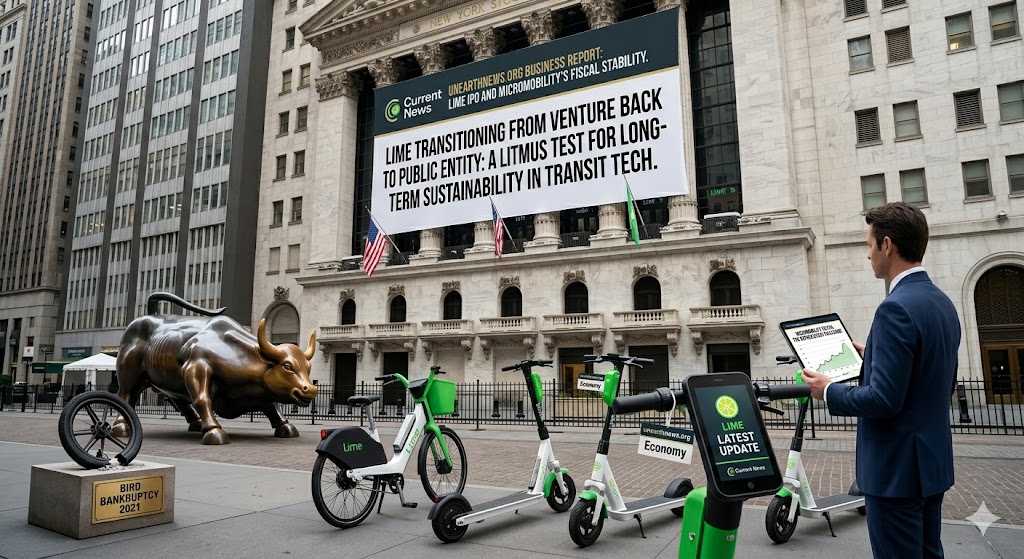
The announcement that Lime, the San Francisco-based micromobility giant, is moving forward with plans for an initial public offering (IPO) marks a pivotal moment for the transit technology sector, particularly as it seeks to distance itself from the historical volatility of its peers. As the company prepares to transition from a venture-backed startup to a publicly traded entity, it carries the weight of an industry that has struggled to prove long-term fiscal sustainability. This move is strategically timed to capitalize on a stabilizing macroeconomic environment, yet it arrives under a cloud of skepticism regarding the inherent unit economics of short-term vehicle rentals. For investors, Lime represents a “pure play” in the e-bike and e-scooter market, a status that has been vacant since the high-profile collapse and subsequent bankruptcy of its primary rival, Bird. The success of this IPO will serve as a litmus test for whether urban micromobility can transition from a subsidized convenience to a profitable infrastructure staple.
The ghost of Bird’s turbulent public tenure looms large over Lime’s road to the Nasdaq or NYSE. Bird’s entry into the public markets via a Special Purpose Acquisition Company (SPAC) in late 2021 initially valued the company at billions, only for its valuation to evaporate as it faced mounting losses and regulatory hurdles. Lime is consciously attempting to differentiate itself by emphasizing operational maturity and a more disciplined approach to capital allocation. Unlike the speculative fervor of the 2021 SPAC boom, the current IPO market demands rigorous evidence of a path to GAAP profitability. Lime’s leadership must convince institutional investors that their hardware-heavy business model can survive the “scooter graveyard” narrative that plagued the first generation of micromobility startups, where vehicle lifespans were too short to recoup their initial capital expenditures.
Central to Lime’s valuation and market confidence is its deep-rooted relationship with Uber, which remains a significant minority shareholder and strategic partner. Uber’s backing provides Lime with more than just capital; it integrates Lime’s fleet into the Uber app, creating a powerful cross-platform ecosystem that lowers customer acquisition costs—a traditionally high hurdle for micromobility firms. As Uber has recently pivoted toward consistent profitability and inclusion in the S&P 500, Lime is under pressure to mirror this fiscal responsibility. The strategic alliance suggests that Lime is not merely a standalone hardware provider but a vital component of a broader “multimodal” transportation strategy. However, this dependency also introduces risks, as any shift in Uber’s corporate priorities or competitive landscape could leave Lime vulnerable to shifts in user traffic and platform fees.
A significant headwind for the upcoming IPO is the mounting concern over Lime’s debt obligations. The company has historically relied on a mix of equity and convertible debt to fund its aggressive global expansion. In an era of elevated interest rates, the cost of servicing this debt has become a primary focal point for analysts. When interest rates were near zero, high-growth tech firms could afford to prioritize scale over margins; however, the Federal Reserve’s restrictive monetary policy has shifted the “cost of carry” for debt-laden balance sheets. If Lime enters the public market with high leverage, it may find that a significant portion of its operating cash flow is diverted to interest payments rather than reinvestment in next-generation hardware or geographic expansion, potentially stifling its growth trajectory.
The broader macroeconomic landscape, specifically the trajectory of inflation and the Federal Reserve’s response, will heavily influence the timing and pricing of Lime’s debut. High interest rates generally compress the valuation multiples of growth-oriented companies because the present value of their future cash flows is discounted more heavily. For Lime to achieve a premium valuation, it must demonstrate that its growth outpaces the drag of inflation on its operational costs. Inflationary pressures on labor, specifically the “gig” workers who charge and relocate scooters, and the rising costs of aluminum and lithium-ion batteries for fleet maintenance, present a constant threat to margins. Investors will be looking for “price inelasticity”—the ability of Lime to raise ride prices without losing its customer base to walking, public transit, or ridesharing.
Operational efficiency, often measured through EBITDA (Earnings Before Interest, Taxes, Depreciation, and Amortization), is the metric Lime has touted to show its readiness for the public eye. While Lime reported its first full year of positive EBITDA in 2022, seasoned analysts remain cautious. In a capital-intensive industry like micromobility, depreciation is a massive and very real expense. Scooters and e-bikes are subject to harsh environmental conditions, vandalism, and rapid technological obsolescence. If the “D” in EBITDA—depreciation—is high because vehicles need replacement every 12 to 18 months, then a positive EBITDA figure can be a misleading indicator of actual net income. Lime’s IPO prospectus will need to provide granular data on vehicle “life-of-product” economics to satisfy the scrutiny of public market value-investors.
The performance of the S&P 500 and the general appetite for risk in the technology sector will also dictate the IPO’s reception. Currently, the market has shown a preference for companies with clear AI integration or software-as-a-service (SaaS) margins, categories that Lime does not naturally inhabit. As a physical logistics and hardware company, Lime must fight for a valuation that reflects its tech-enabled platform rather than being categorized as a traditional transportation company with lower multiples. If the S&P 500 remains near record highs, the “wealth effect” may encourage retail and institutional participation in the IPO; however, a sudden correction or a spike in volatility (VIX) could shut the IPO window entirely, forcing Lime to seek more expensive private bridge financing.
Consumer demand dynamics are another critical variable in the economic equation. Micromobility is often viewed as a discretionary expense for tourists or a “last-mile” solution for commuters. In a cooling economy where real disposable income might be squeezed by persistent inflation in essential services like rent and insurance, consumers may opt for cheaper alternatives. Lime must prove that its service has become a utility—an essential part of the urban fabric—rather than a novelty. The company’s expansion into e-bikes is a strategic move to capture longer-distance trips and a more diverse demographic of riders, which could stabilize revenue streams across different seasonal and economic cycles, reducing the cyclicality that often scares off long-term investors.
Regulatory risk remains perhaps the most unpredictable factor in Lime’s financial outlook. Major markets such as Paris have recently moved to ban or severely restrict rental e-scooters, citing safety concerns and sidewalk clutter. Each city Lime operates in represents a unique regulatory environment with varying permit fees, fleet caps, and insurance requirements. These “soft costs” of doing business can fluctuate wildly based on local political climates. For a public company, this creates a lack of geographic predictability. Lime’s ability to secure multi-year exclusive contracts with major metropolitan areas will be a key indicator of its defensive “moat,” allowing it to protect its market share against smaller, localized competitors who may engage in price wars.
The longevity and durability of Lime’s hardware, specifically its Gen4 and Gen5 models, are central to its long-term profitability. In the early days of the industry, consumer-grade scooters were used for commercial purposes, leading to lifespans measured in weeks. Today, Lime designs its own hardware, which it claims can last up to five years with proper maintenance. This extension of the asset’s lifecycle is the primary driver of margin expansion. By reducing the frequency of capital outlays for new fleets, Lime can theoretically generate significant free cash flow. However, the rapid pace of battery technology and motor efficiency improvements means that even a durable scooter may become competitively obsolete before its physical end-of-life, necessitating a delicate balance between maintenance and replacement cycles.
The IPO also serves as an exit or liquidity event for early-stage venture capital firms and employees who have been with the company through its various funding rounds, including its 2020 acquisition of Uber’s Jump bike business. This transition from private to public hands often leads to a period of stock price volatility as early investors rebalance their portfolios and “lock-up” periods expire. Prospective public investors must weigh the potential for dilution against the benefits of increased transparency and capital access that a public listing provides. For Lime, the primary goal of the IPO is likely to raise sufficient capital to pay down its high-interest debt and provide a “war chest” for further international expansion and R&D into autonomous fleet repositioning technology.
In conclusion, Lime’s pursuit of an IPO is a high-stakes gamble on the maturity of the micromobility sector. While the company has demonstrated impressive growth and a closer alignment with profitability than its predecessors, the underlying economic challenges of debt servicing, hardware depreciation, and regulatory instability remain significant hurdles. Success will require Lime to navigate a complex macroeconomic environment where interest rates and investor sentiment are in constant flux. If Lime can prove that it has solved the unit economic puzzles that broke Bird, it may well become the blueprint for a new generation of sustainable, tech-enabled urban transport. If not, its IPO could serve as a final warning that the micromobility “pure play” model is fundamentally at odds with the demands of the public markets.